Material guide
5 Filament Brands With Tight Tolerances and Strong Layer Adhesion
From planning to printing
Find material for your next print
Compare current colors, prices, and setup requirements before choosing a spool for your project.
Share this guide
Get the article link

Last Updated: November 7, 2026
Quick Summary
LineBoss Filament holds its 1.75 mm filament to +/-0.02 mm, a filament diameter tolerance that keeps extrusion volume predictable from the first layer to the last. For layer adhesion, choose a material that bonds well at temperatures your printer can hold, such as PETG or impact-modified PLA+, and keep the spool dry.
- Measure diameter at several spots across the spool and record ovality at each one.
- A strand 0.05 mm under nominal delivers roughly five percent less material per step.
- Moisture is the quiet killer of bond strength, so dry spools per the label.
- Match material to failure mode: PLA+ for shock loads, ASA for UV and weather.
- All five LineBoss spools ship as 1.75 mm, 1 kg, vacuum sealed with desiccant.
Table of Contents
- Filament Diameter Tolerance and Layer Adhesion: What Decides Functional Part Quality
- Quick Comparison: Five LineBoss Filaments for Functional Parts
- How Filament Diameter Tolerance Affects Extrusion and Print Consistency
- Best Filament for Layer Adhesion: What to Look For and Which LineBoss Spool Fits
- Best Filament for Functional Parts: Matching Material to Failure Mode
- PETG vs PLA for Functional Parts: Strength, Heat and Layer Bonding
- Spool-to-Spool Consistency and Batch Variation: What to Verify Before You Buy
- Choosing Your LineBoss Spool for the Next Functional Build
- Frequently Asked Questions
Filament Diameter Tolerance and Layer Adhesion: What Decides Functional Part Quality
Filament diameter tolerance is the allowed variation in a spool's cross-section, and it decides whether a functional part prints to size or fails at the layer line. A spool that swings wide forces the extruder to over- or under-fill, and no slicer profile fully corrects for it. LineBoss Filament holds its 1.75 mm filament to +/-0.02 mm, which keeps extrusion volume predictable from the first layer to the last.
Two variables separate a part that holds a load from one that splits. The first is dimensional consistency: diameter and ovality held tight enough that flow stays stable. The second is interlayer bonding, where polymer chains across the layer boundary influence part strength.
Below is a practical breakdown of what to verify, how to test it yourself, and which LineBoss spool fits each kind of functional build. Note one limit up front: no brand-level diameter or bond-strength figures are published here. What follows is the verification method and the material reasoning, not a leaderboard.
Quick Comparison: Five LineBoss Filaments for Functional Parts
| Filament | Price | Best For | Key Trait |
|---|---|---|---|
| PETG-CF | $18.99 | Jigs, fixtures, brackets | Carbon-fiber reinforced, low-sheen |
| PETG | $12.99 | Everyday mechanical parts | Impact resistance, low warping |
| ABS | $17.99 | Heat-exposed enclosures | High temperature resistance |
| ASA | $18.99 | Outdoor-facing parts | UV and weather resistance |
| PLA+ | $14.99 | Prototypes, cosplay | Impact-modified, easy printing |
Price
All five ship as 1.75 mm, 1 kg spools, vacuum sealed with desiccant.
How Filament Diameter Tolerance Affects Extrusion and Print Consistency
Extrusion is volumetric, so small diameter errors compound. A filament running under nominal deposits less plastic than the slicer expects, leaving gaps and weak bonds between walls. A spool running over nominal over-extrudes, building ridges and dimensional drift on the outside of the part. The mechanism is simple: flow rate scales with the square of the radius, so a strand that is 0.05 mm under nominal delivers roughly five percent less material per step than a strand at nominal.
Ovality matters as much as average diameter. A strand that is round on one axis and flattened on the other feeds unevenly as it rotates through the drive gears, producing banding that looks like a mechanical fault but is really a material fault. Ovality is the difference between the largest and smallest diameter reading at a single cross-section, and it is the number most spool labels never publish.
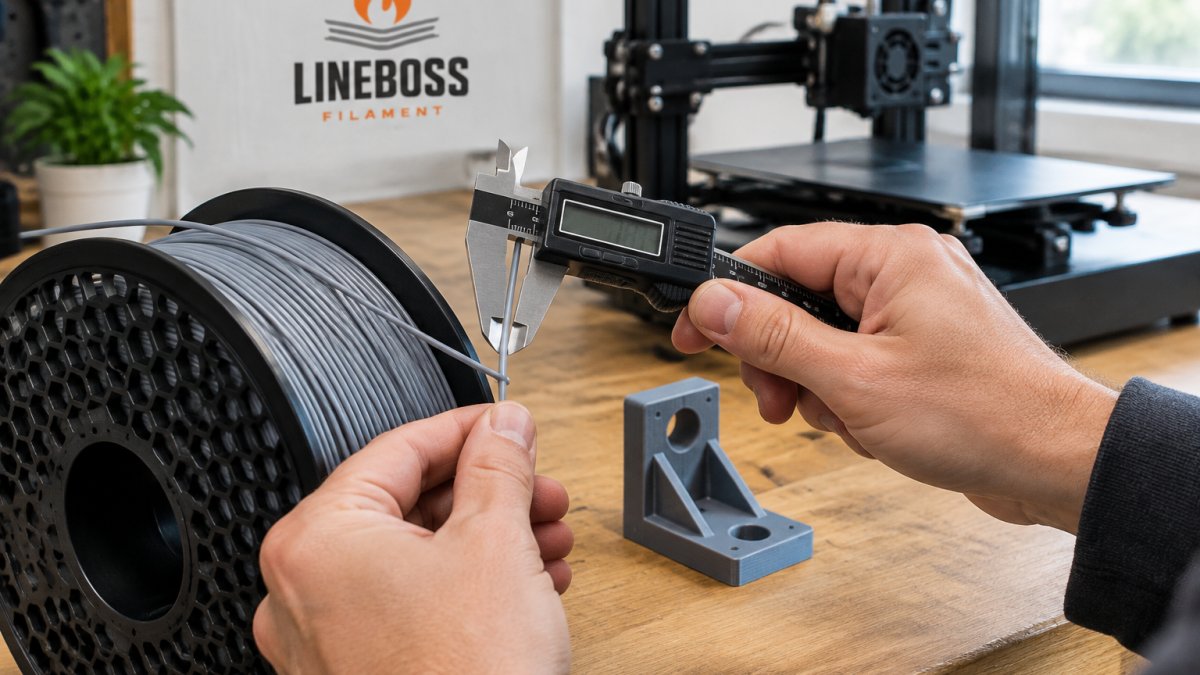
A practical measurement protocol beats trusting the label. Use calipers with fine resolution, measure at several spots spread across the spool, and record both the diameter and the ovality at each spot. Rotate the caliper jaws 90 degrees at each location to catch flattening. Note the spread between the smallest and largest reading, not just the average. If the spread is wider than the spec claims, expect the spool to need extra flow tuning.
Watch out: calipers read soft filament differently depending on jaw pressure, so use light, consistent contact and let the tool settle before reading. A heavy squeeze on PETG or PLA+ can compress the strand and understate the true diameter.
LineBoss Filament holds its 1.75 mm filament to +/-0.02 mm, which keeps extrusion volume predictable from the first layer to the last. Verify the tolerance on your own spool before committing a full roll to a critical part. For a full walkthrough on reading spool specs and measuring your own stock, see how to choose filament diameter tolerance. For slicer-side flow calibration that compensates for the tolerance you measure, see the slicer settings guide.
Best Filament for Layer Adhesion: What to Look For and Which LineBoss Spool Fits
The best filament for layer adhesion is one whose polymer bonds well at the temperatures your printer can actually hold, and whose moisture content is low at the moment of printing. Bond strength is a material property first and a brand property second. That ordering matters, because most weak-bond complaints trace back to moisture, temperature, cooling, or print speed long before they trace back to the spool.
Interlayer bonding is a polymer-chain diffusion problem. When the nozzle lays down a new bead, the hot polymer must melt into the surface of the layer below and let chains migrate across the boundary before the bead cools.
What to look for:
- A material known for interlayer bonding, such as PETG or impact-modified PLA+
- Vacuum sealing with desiccant, so the spool arrives dry
- A published starting profile you can tune from, rather than guesswork
- A stated diameter tolerance, since inconsistent flow undermines bonding even with a good polymer
LineBoss PETG is a strong everyday pick here. Its listing cites excellent layer adhesion and low shrinkage. LineBoss PLA+ uses impact modifiers so parts bend before they snap, which helps on brackets that see shock loads. LineBoss PETG-CF adds stiffness for jigs and fixtures, but the carbon fiber is abrasive, so plan on a hardened or wear-resistant nozzle.
Before changing brands, diagnose the bond you already have. Print a small test specimen in the orientation your part will see load, then break it and look at the fracture surface. A clean, glassy break that follows the layer lines points to a bonding problem; a rough, jagged break that crosses layers points to a material strength limit. If the break follows the layers, check moisture first, then nozzle temperature against the material maker's range, then cooling and speed. Only after those are ruled out does the spool itself become the suspect.
Watch out: moisture is the quiet killer of bond strength. A wet spool pops and foams at the nozzle, and those voids become the failure line. Dry according to the spool label and your dryer's temperature limits. For a deeper troubleshooting path on temperature, cooling and drying, read how to improve layer adhesion. For cost-per-part math when comparing materials, use the 3D printing cost calculator.
Best Filament for Functional Parts: Matching Material to Failure Mode
Matching the filament to how the part will fail is more useful than picking by reputation.
- Snapping under sudden load: PLA+ bends before breaking
- Creeping under steady load or heat: ABS or ASA hold shape better
- Cracking from sunlight and rain: ASA resists UV and weather
- Wear at a contact point: PETG-CF adds rigidity and a hard, low-sheen surface
A common mistake is choosing one material for every job. A jig that lives on a workbench and a mount that lives outdoors have different enemies. Match the material to the enemy, then tune the profile.
PETG vs PLA for Functional Parts: Strength, Heat and Layer Bonding
PETG suits functional parts that see load, heat or moisture, while PLA+ suits prototypes, display pieces and cosplay where ease of printing matters most.
PETG brings ABS-like rugged strength with PLA-like ease of printing, plus low warping and water resistance for outdoor use. PLA+ keeps beginner-friendly behavior but adds toughness and slightly higher heat resistance than standard PLA. On layer bonding, both bond well when dry and printed at the material maker's recommended range;
The real difference comes down to service conditions. If the part sits in a hot car or a sunny window, PLA+ will soften. If the part needs to shrug off a drop, PETG's impact resistance is the safer bet. For a direct side-by-side on strength, heat and outdoor use, see choosing between PLA and PETG.
Spool-to-Spool Consistency and Batch Variation: What to Verify Before You Buy
Batch variation is the difference between two spools of the same material bought months apart, and it is where small brands often lose trust. Consistency across spools matters more than any single spool's spec sheet, because a print farm cannot re-tune for every roll.
What to verify before buying:
- The stated diameter tolerance, in writing
- Whether spools are vacuum sealed with desiccant
- Whether the seller publishes a starting profile per material
- Whether support exists for tuning problems
- Whether you can measure and compare rolls yourself
A repeatable protocol beats a marketing claim. Measure diameter at several points, check ovality, and run the same test print on each new spool. For a structured method, follow how to compare filament consistency.
Choosing Your LineBoss Spool for the Next Functional Build
Pick by failure mode, then confirm the tolerance. For rigid brackets, jigs and fixtures, LineBoss PETG-CF at $18.99 gives a stiff, low-sheen black part, though it needs a hardened or wear-resistant nozzle because the carbon fiber is abrasive. For general mechanical parts and outdoor tools, LineBoss PETG at $12.99 is the workhorse. For heat-exposed enclosures, ABS at $17.99; for sun and rain, ASA at $18.99; for prototypes and cosplay, PLA+ at $14.99.

Every spool is 1.75 mm, 1 kg, vacuum sealed with desiccant, and backed by practical profile help. Free U.S. shipping applies over $50. Before committing a full spool to a critical part, run a small test print and measure the result.
Functional parts punish inconsistency, and the fix starts with a spool you can trust. LineBoss Filament builds around +/-0.02 mm diameter tolerance, vacuum sealing with desiccant, and product-specific setup support so tuning is a conversation, not a guess. Start with a single spool, measure it, print a test bracket, and let the results decide. Get started with LineBoss Filament and print functional parts that hold their dimensions.
Frequently Asked Questions
Which filament brands have the most consistent diameter?
Consistency comes down to the tolerance a brand publishes and holds across batches. LineBoss states a +/-0.02 mm filament diameter tolerance on its 1.75 mm spools. Ask any brand for its stated tolerance and how it checks ovality, not just a single average reading. A tight tolerance plus vacuum sealing with desiccant is the practical combination that keeps print reliability steady across a batch.
Does filament diameter consistency affect print strength?
Yes, indirectly. When filament diameter swings, the slicer's flow calculation is off, so extrusion width varies and layers can under- or over-pack. That shows up as weak interlayer bonding, gaps and inconsistent walls, especially in functional parts. A tight filament diameter tolerance helps keep the commanded flow close to the actual bead. It does not replace correct temperature and cooling settings, but it removes one variable from the equation.
What is the best filament for layer adhesion in functional parts?
PETG is a strong starting point because LineBoss lists excellent layer adhesion alongside high impact resistance and low warping. PLA+ suits prototypes and cosplay parts, with an impact-modified formula that bends before breaking. For heat or outdoor exposure, ASA and ABS offer temperature and UV resistance, and an enclosure with stable chamber temperature and appropriate ventilation is recommended. Match the material to the load, heat and weather the part will see.
PETG vs PLA for functional parts: which should I pick?
Pick PETG when the part takes impacts, sits outdoors or needs water resistance, since LineBoss PETG is listed as stronger than PLA and easier than ABS. Pick PLA+ for detailed prototypes, display pieces and household prints where print ease and surface finish matter more than heat resistance. Both are offered as 1.75 mm spools, so the decision is largely about service conditions. Use the slicer settings resource to tune each material for your machine.
How do I check filament diameter tolerance on a new spool?
Measure with digital calipers at several points around the filament and along its length, then compare the spread to the brand's stated tolerance. LineBoss publishes +/-0.02 mm, so Also check for ovality by measuring the same spot at 90 degrees. Log the results per spool so batch variation becomes visible over time, and store spools sealed with desiccant between prints.
