Material guide
Atomic vs Proto-Pasta Alternatives for Engineering-Grade Filament
From planning to printing
Find material for your next print
Compare current colors, prices, and setup requirements before choosing a spool for your project.
Share this guide
Get the article link

Last Updated: November 13, 2026
Quick Summary
LineBoss Filament offers four engineering-grade filament options: PETG at $12.99 for impact resistance, ABS at $17.99 for heat resistance, ASA at $18.99 for UV and weather resistance, and PETG-CF at $18.99 for rigidity. All ship as 1.75 mm filament on 1 kg spools with a +/-0.02mm diameter tolerance.
- PETG-CF is the stiffest spool but carbon-fiber filler lowers elongation, so unfilled PETG is tougher.
- Carbon-fiber-filled filament is abrasive and requires a hardened or wear-resistant nozzle instead of brass.
- ABS and ASA both benefit from an enclosure and stable chamber temperature to limit warping.
- Nylon offers genuine flex toughness but is the most moisture-sensitive common material and hardest to print.
- Match material to service conditions: PETG for prototypes, ABS for heat, ASA for outdoors, PETG-CF for rigid fixtures.
Table of Contents
- What Makes Engineering-Grade Filament Different
- Comparison Table: LineBoss Engineering-Grade Filament Options
- Best Engineering-Grade 3D Printer Filament for Functional Prototypes
- Nylon Filament for 3D Printing: What to Know Before You Switch
- 3D Printer Nozzle Compatibility for Filled and Abrasive Filaments
- Filament Drying and Storage for Moisture-Sensitive Materials
- Choosing the Right LineBoss Spool for Your Application
- Frequently Asked Questions
What Makes Engineering-Grade Filament Different
Engineering-grade filament is a 3D printing material specified for mechanical function rather than appearance alone, and the difference shows up in how the printed part behaves under load, heat, and time.
Diameter tolerance matters more than most buyers expect. A spool that drifts in diameter changes extrusion width, and that changes wall strength. LineBoss holds a +/-0.02mm tolerance and vacuum seals every spool with desiccant.
Material properties are the second half of the story. Stiffness, impact resistance, heat tolerance, and chemical resistance pull against each other, so a material that feels rigid is not automatically the tougher choice. At LineBoss Filament, the starting point is how the finished part will be used.
Comparison Table: LineBoss Engineering-Grade Filament Options
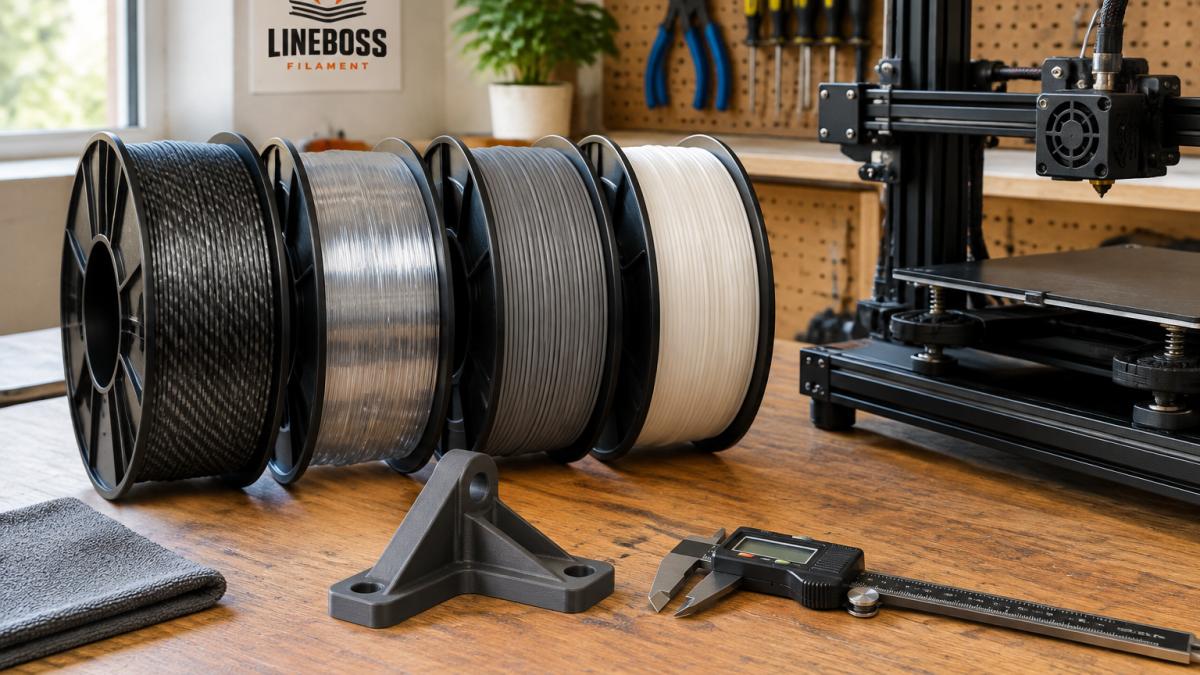
Four LineBoss spools cover most functional work, and the table below maps each to its best application. To browse the full functional and engineering filament lineup, including PETG, PLA+, Carbon Fiber PLA, ABS, ASA, and flexible TPU, see the shop page. All four ship as 1.75 mm filament on 1 kg spools.
| Filament | Price | Key Property | Best For |
|---|---|---|---|
| PETG | $12.99 | Impact resistance, low warping | Brackets, jigs, organizers |
| ABS | $17.99 | Heat resistance, toughness | Enclosures, tooling, mounts |
| ASA | $18.99 | UV and weather resistance | Outdoor-facing parts |
| PETG-CF | $18.99 | Rigidity, low-sheen finish | Fixtures, housings, prototypes |
Price
PETG is a practical everyday choice. ABS and ASA both benefit from an enclosure and stable chamber temperature. PETG-CF is the stiffest of the four and needs a wear-resistant nozzle.
Best for: PETG suits most everyday functional parts. Skip if: the part sees sustained heat, where ABS or ASA is the better fit.
Mapping Materials by Property, Not by Label
A price-and-blurb table is a starting point, not a decision tool. The gap most brand comparisons leave open is a like-for-like read across the properties that actually govern a functional part: stiffness, impact resistance, heat deflection, chemical resistance, and processing difficulty.
| Property driver | Strongest fit in the lineup | Weaker fit | Practical constraint |
|---|---|---|---|
| Stiffness and dimensional stability | PETG-CF | PETG | Abrasive filler requires a hardened or wear-resistant nozzle |
| Impact and drop resistance | PETG | PETG-CF | Filler reduces elongation; rigid is not the same as tough |
| Sustained heat exposure | ABS, ASA | PETG | Both want an enclosure and stable chamber temperature |
| UV and weather exposure | ASA | ABS | ABS degrades faster outdoors; ASA is the outdoor-facing choice |
| Ease of first successful print | PETG | PETG-CF | Filled material punishes inconsistent extrusion |
Two patterns fall out of that mapping. First, the stiffest spool is rarely the toughest one: carbon-fiber reinforcement raises rigidity and lowers elongation, so a part that must flex or absorb a drop is usually better served by unfilled PETG. Second, heat and UV resistance are separate problems. ABS is suited to heat exposure but not sustained sunlight; ASA is listed for UV and weather resistance.
What the Table Cannot Tell You
A comparison table drawn from product data is not a test report. Printed-part performance depends on layer orientation, infill, wall count, and conditioning, so validate the actual part with a small test print on the machine that will run the job.
Processing requirements belong in the same decision. Those constraints change the true cost of a spool, which is why the 3D printing cost calculator is a better comparison tool than the sticker price alone. Starting profiles for each material are published at slicer settings.
Best Engineering-Grade 3D Printer Filament for Functional Prototypes
For functional prototypes, the best engineering-grade filament is the one that matches the prototype's test conditions, not the one with the highest headline strength. A bracket that will be bolted and loaded needs stiffness and creep resistance.
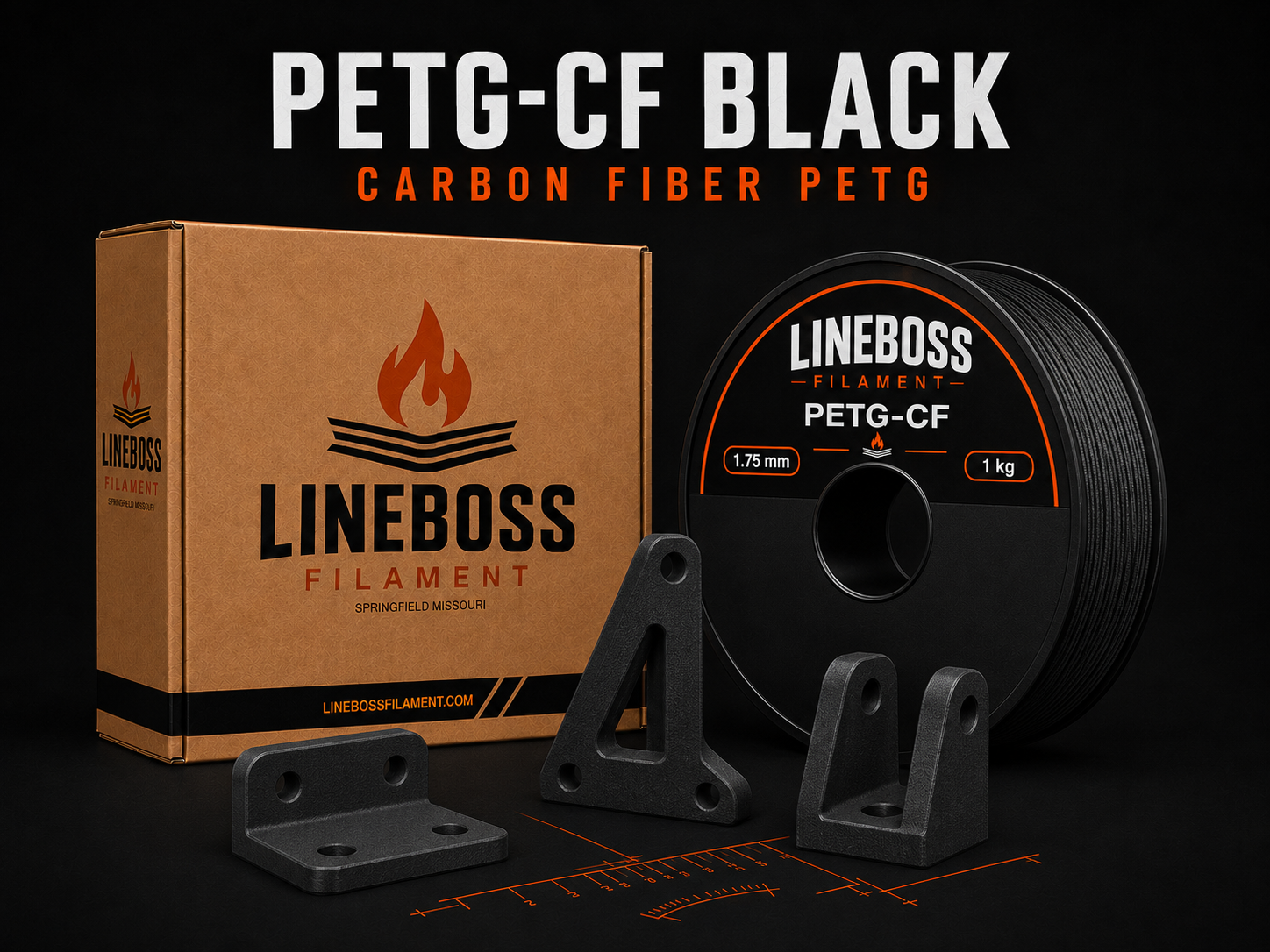
LineBoss PETG-CF Black covers the stiffness case well. The carbon-fiber reinforcement gives it a rigid, textured, low-sheen finish that reads as a working part rather than a display piece, which is why it suits brackets, jigs, fixtures, housings, and technical prototypes.
One honest limitation: reinforcement does not create a certified load or temperature rating. Layer orientation and part design still decide whether the prototype holds up, so validate both before trusting a printed part in service.
Nylon Filament for 3D Printing: What to Know Before You Switch
Nylon filament for 3D printing offers excellent toughness and layer adhesion, but it is also the most moisture-sensitive common material and the hardest to print consistently. Nylon absorbs water from the air quickly, and wet nylon prints with popping, stringing, and weak layers.
The material also warps. Nylon shrinks as it cools, and large flat parts are where that shows up first. An enclosure helps. So does part orientation and a brim.
For most functional parts, PETG and ABS cover similar ground with far less fuss. Nylon earns its place when a part needs genuine flex toughness or chemical resistance that the styrenes cannot match. Where does that leave the buyer comparing engineering-grade filament?
3D Printer Nozzle Compatibility for Filled and Abrasive Filaments
Carbon-fiber-filled filaments such as PETG-CF are abrasive and can wear standard brass nozzles, so a hardened or wear-resistant nozzle is recommended. Nozzle wear is gradual, so the symptom is usually a part that prints slightly differently after several spools rather than an obvious failure.
Why Abrasion Happens and What It Changes
Carbon-fiber, glass-fiber, and other mineral-filled filaments carry hard particles through the melt zone at print speed. Brass is soft, and the particles act like a slow abrasive on the orifice and the internal bore. The result is not a sudden clog but a drift: the exit diameter grows, extrusion width widens, and wall thickness becomes inconsistent from spool to spool.
Nozzle material is the first fix. Hardened steel, ruby-tipped, and other wear-resistant nozzles resist abrasion far better than brass. The trade-off is thermal: some hardened nozzles conduct heat less efficiently than brass, so the temperature and flow settings that worked on brass may need retuning on the new nozzle. Treat a nozzle swap as a settings change, not a drop-in replacement.
Nozzle Size and the Measurement Habit
Nozzle size is a separate decision from nozzle material. A practical approach is to pick nozzle size from the smallest filament diameter actually measured, not from the label. Measuring ten points along a spool with calipers gives a real number to work from, and the guidance in How to Pick Nozzle Size for Variable Diameter Filament walks through that measurement step by step. A 0.6 mm wear-resistant nozzle is a common starting choice for filled material because the larger orifice is more tolerant of the slight diameter variation that filled spools can show.
Carbon-fiber-filled filament is abrasive and can wear standard brass nozzles, so confirm your nozzle before printing with it.
The Wider Processing-Constraint Checklist
Nozzle compatibility is one line in a longer checklist that decides whether an engineering material succeeds on a given printer. The constraints below are the ones most often missed when a buyer moves from a general-purpose spool to a filled or high-temperature one.
- Nozzle material: hardened or wear-resistant for any filled filament; brass is fine for unfilled PETG, ABS, and ASA.
- Nozzle size: larger orifices tolerate diameter variation better; smaller orifices print finer detail but clog more readily with filler.
- Enclosure: ABS and ASA want a stable chamber temperature to limit warping and layer splitting; PETG and PETG-CF are more forgiving but still benefit from draft control.
- Bed and chamber temperature: follow the material maker's limits rather than a universal profile; the right number depends on the specific spool and the printer's heated bed capability.
- Drying and storage: moisture-sensitive materials need a dryer and sealed storage before the first print, not after the first failure.
- Ventilation: ABS and ASA benefit from appropriate ventilation during printing.
That checklist is the practical difference between a material that prints reliably and one that produces a single good part followed by a run of failures. It also changes the true cost of a spool, which is why the 3D printing cost calculator is worth running before committing to a filled or high-temperature material. Starting profiles and hardware notes for each LineBoss material are published at slicer settings.
Best for: buyers moving from unfilled to filled or high-temperature material who need to know what hardware changes first. Skip if: the printer has no enclosure and no path to one, in which case PETG or PETG-CF is the realistic ceiling for functional work.
Filament Drying and Storage for Moisture-Sensitive Materials
Dry storage helps keep moisture-sensitive filament performing consistently. The routine is simple: keep spools sealed with desiccant between uses, dry when symptoms appear, and record what worked.
Moisture symptoms can include popping or crackling at the nozzle and stringing. When those appear, dry according to the spool label and the temperature limits of both the spool and the dryer.
The choice of dryer matters too. Filament Dryers for Consistent 3D Printing: What to Look For covers the features worth checking before buying one. Storage is the cheaper half of the fix: a sealed container with fresh desiccant keeps a dried spool dry for months.
Choosing the Right LineBoss Spool for Your Application
Matching material to application is the whole decision, and it narrows quickly once the part's job is clear. Start with the service conditions, then pick the spool.
- Prototypes and decorative pieces: PETG, which the listing describes as easy to print and stronger than PLA.
- Functional parts with heat exposure: ABS, printed with an enclosure and ventilation.
- Outdoor-facing parts: ASA, for UV and weather resistance.
- Rigid fixtures and housings: PETG-CF, with a wear-resistant nozzle.
Buyers comparing engineering-grade filament should weigh net spool weight, printer compatibility, nozzle requirements, and total delivered cost rather than headline price alone. The full lineup is browsable by application at shop filament by project, which groups spools by everyday printing, functional parts, outdoor use, and display work.
A common mistake is treating every spool as interchangeable. The other is trusting a print profile as a guarantee. LineBoss Filament publishes starting profiles at slicer settings and offers setup help.
The gap between a part that survives service and one that fails usually traces back to material selection, not printer skill. LineBoss Filament stocks PETG, ABS, ASA, and PETG-CF with +/-0.02mm diameter tolerance, vacuum-sealed spools with desiccant, and product-specific setup support to shorten the tuning curve.
Frequently Asked Questions
What brands make engineering-grade filament, and how do I compare them?
Brands differ in material families, tolerances, and documentation. Compare diameter tolerance, net spool weight, stated material properties, and printer requirements like nozzle type and enclosure needs. LineBoss Filament lists 1.75 mm diameter, 1 kg spools, and material-specific starting guidance for PETG, PETG-CF, ABS, and ASA. Ask for technical data sheets where available and treat general marketing claims as starting points, not guarantees.
Does engineering-grade filament require a hardened steel nozzle?
Only abrasive materials do. Carbon-fiber-filled filament like LineBoss PETG-CF wears standard brass nozzles, so a hardened or wear-resistant nozzle is recommended, with 0.6 mm a practical starting choice. Unfilled PETG, ABS, and ASA do not carry that requirement in their listings. Confirm your printer and feeder support abrasive composite filament before switching nozzles.
Which engineering filaments need an enclosed 3D printer?
ABS and ASA benefit most from an enclosure, stable chamber temperature, and ventilation, according to LineBoss product guidance. PETG and PETG-CF print without that requirement, though a consistent environment helps dimensional accuracy. Nylon is moisture-sensitive and typically benefits from drying and sealed storage. Match the printer setup to the material before buying a spool.
How do I dry and store moisture-sensitive 3D printer filament?
Keep spools sealed with desiccant between uses. If moisture symptoms appear, dry according to the spool label and the temperature limits of both the spool and your dryer. LineBoss ships filament vacuum sealed with desiccant to support this. Avoid kitchen-oven drying, which can exceed spool temperature limits. Record successful settings so repeat jobs are easier to reproduce.
