Material guide
Atomic Filament Alternative for Print Farms: A Buyer's Guide
From planning to printing
Find material for your next print
Compare current colors, prices, and setup requirements before choosing a spool for your project.
Share this guide
Get the article link

Last Updated: November 16, 2026
Quick Summary
An atomic filament alternative for print farms should offer repeatable extrusion, spool-to-spool consistency, and responsive support. LineBoss Filament publishes a ±0.02 mm diameter tolerance, vacuum seals every spool with desiccant, and provides product-specific setup help. Test any supplier's consistency before committing to a bulk order.
- LineBoss PETG costs $12.99 per spool and suits brackets, jigs, fixtures, and outdoor parts.
- PETG-CF requires a hardened or wear-resistant nozzle; LineBoss suggests a 0.6 mm wear-resistant nozzle as a starting point.
- Measure diameter at five points along the first meter and five more mid-spool with calipers.
- Compare bulk filament on delivered cost per kilogram, not headline spool price.
- Record winning print settings per printer, since identical machines can need different retraction values.
Table of Contents
- What Print Farms Actually Need From a Filament Supplier
- Material Comparison for High-Volume Printing
- The Best PETG Filament for 3D Printing in a Farm Setting
- How to Test Filament Consistency Before Committing to a Bulk Order
- PETG Filament Settings to Start From and Tune
- Buying Bulk 3D Printer Filament for Print Farms Without Overpaying
- Matching Filament to Your Farm's Workload
- Stocking Your Farm With LineBoss Filament
- Frequently Asked Questions
What Print Farms Actually Need From a Filament Supplier
An atomic filament alternative for print farms has to solve a different problem than a spool bought for a weekend project, which is why the search for an atomic filament alternative for print farms starts with repeatability. A farm needs repeatable extrusion, spool-to-spool consistency, and a supplier who answers questions about nozzle wear and drying before the order ships.
LineBoss Filament builds its catalog around that reality. The company publishes a ±0.02 mm diameter tolerance, vacuum seals every spool with desiccant, and offers product-specific setup help rather than a generic settings sheet. Those three details matter more on a farm than any single material claim.
What separates a farm-grade supplier from a hobby-grade one comes down to four things:
- Dimensional consistency, so the same profile works across every machine on the rack
- Moisture control, because a wet spool prints differently from a dry one even at identical settings
- Documented material behavior, including which filaments wear standard brass nozzles
- A real support channel when a spool misbehaves mid-batch
Most buying guides skip the fourth item. On a farm running multiple printers, a support question answered in a day can save a full production run.
Material Comparison for High-Volume Printing
No single filament wins across every workload. The right pick depends on how the finished part will be used, and that question should come before price, color, or brand.
| Material | LineBoss Price | Strength Profile | Heat and Weather | Nozzle Note |
|---|---|---|---|---|
| Standard PLA | $12.99 | Rigid, brittle under stress | Indoor use | Standard brass fine |
| PLA+ | $14.99 | Tougher, bends before breaking | Slightly higher than PLA | Standard brass fine |
| PETG | $12.99 | High impact resistance | Water-resistant, outdoor-capable | Standard brass fine |
| ABS | $17.99 | Strong, heat-resistant | High temperature resistance | Enclosure recommended |
| PETG-CF | $18.99 | Rigid, low-sheen finish | PETG base with reinforcement | Hardened nozzle required |
LineBoss Price
PLA and PLA+ for Fast Prototyping
Standard PLA is the cheapest path to a finished prototype. LineBoss PLA prints at lower nozzle temperatures and holds crisp detail, which suits dimensional checks, decorative pieces, and light-duty parts.
The tradeoff is brittleness. Standard PLA is more brittle than PLA+ and can snap suddenly under high stress, while PLA+ uses impact modifiers that let a part bend slightly before it breaks.
PETG for Durable Production Parts
PETG is the workhorse for repeat production. LineBoss PETG combines PLA-like printing ease with ABS-like strength, low warping, and water resistance for outdoor use. That combination covers brackets, jigs, fixtures, and organizers without demanding an enclosure.
PETG does not always behave like PLA, so it is worth calibrating each printer before committing a spool to production.
ABS and PETG-CF for Demanding Applications
LineBoss ABS is engineered to reduce cracking and warping on large prints. Use an enclosure, stable chamber temperature, and appropriate ventilation.
PETG-CF is the choice when rigidity and a low-sheen finish matter. Carbon-fiber reinforcement is abrasive and will wear standard brass nozzles, so a hardened or wear-resistant nozzle is required. LineBoss suggests a 0.6 mm wear-resistant nozzle as a practical starting point and notes that reinforcement does not establish a certified load or temperature rating.
The Best PETG Filament for 3D Printing in a Farm Setting
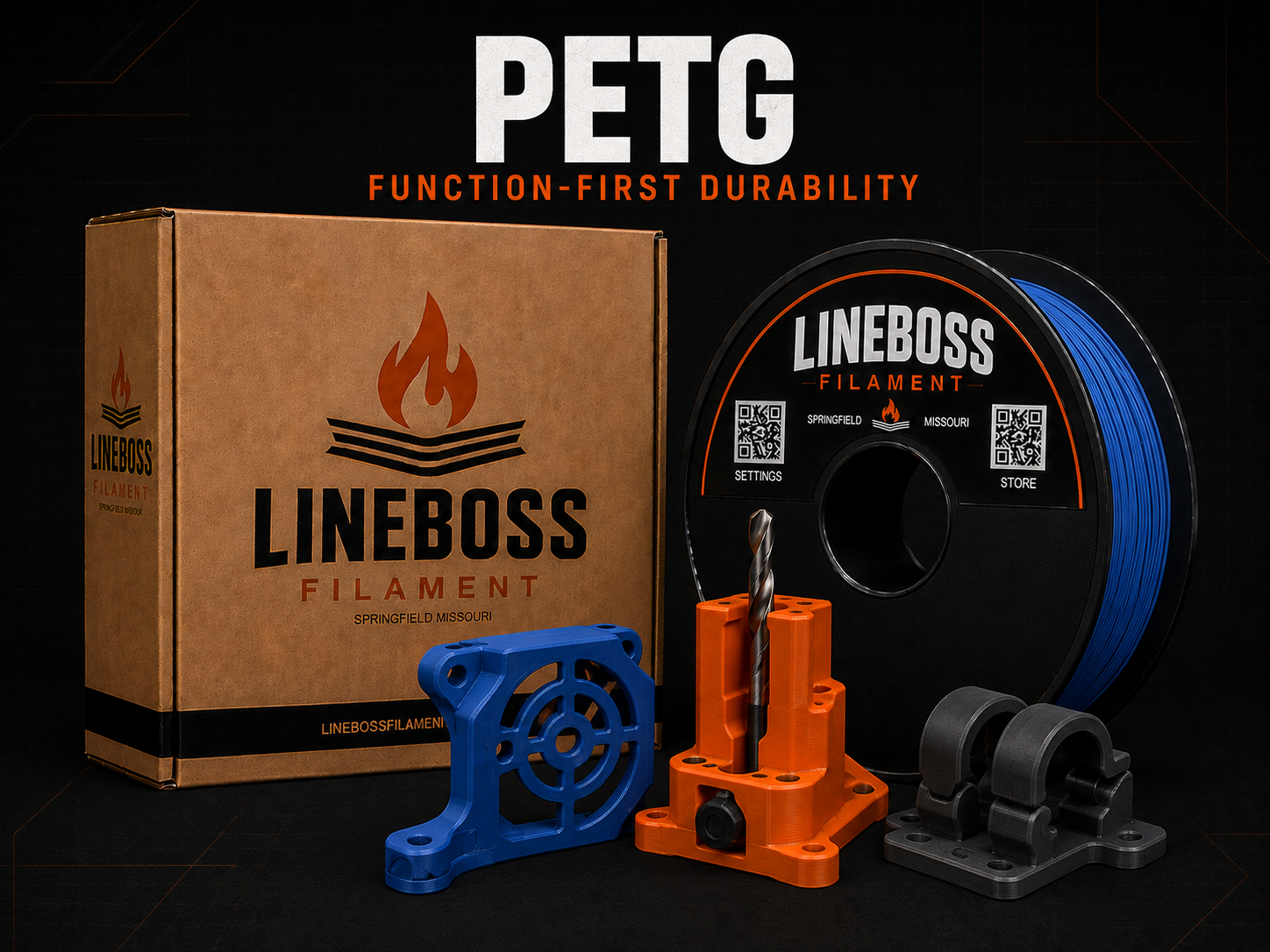
For many practical parts, LineBoss PETG is a sensible choice. It combines PLA-like printing ease with impact resistance, low shrinkage, and water resistance, and it is priced at $12.99 per spool.
The product listing describes low warping, a tangle-free, no-clogging winding, and vacuum sealing with desiccant for moisture-free storage.
For applications needing higher heat resistance, compare LineBoss ABS. For mechanical parts and outdoor tools, LineBoss PETG filament is a practical starting spool.
How to Test Filament Consistency Before Committing to a Bulk Order
Filament consistency is the measurable agreement between spools in diameter, color, and print behavior under identical settings. A supplier can claim tight tolerance; only a repeatable test confirms it holds across a batch.
Run this protocol on every new supplier before a volume order:
- Measure diameter at five points along the first meter and five more mid-spool with calipers
- Record ovality by measuring the same point at two perpendicular angles
- Print the same small test part from three different spools at identical settings
- Compare part weight and dimensional accuracy across all three
- Photograph each result under the same lighting for color comparison
- Log moisture symptoms: popping sounds, stringing, or surface bubbles
A farm that skips this step discovers inconsistency mid-production, when a failed batch costs far more than the test. LineBoss publishes a filament consistency testing guide with a fuller protocol covering diameter, ovality, color, and spool variation.
PETG Filament Settings to Start From and Tune
PETG filament settings are a starting point, not a guarantee. Print settings depend on your printer, hotend, part cooling, and environment, so treat any starting profile as a baseline to tune.
Start with the spool label and the printer manufacturer's PETG guidance, then calibrate in this order:
- Confirm the nozzle and bed are clean and the build surface is fresh
- Print a temperature tower across the manufacturer's stated range
- Tune flow so walls measure to spec with calipers
- Adjust retraction in small increments to control stringing
- Print a small test part and record every setting that worked
Record the winning settings per printer, not per material. Two identical machines in different corners of a shop can need different retraction values. A PETG starter profile and calibration workflow covers the full sequence for beginners.
Buying Bulk 3D Printer Filament for Print Farms Without Overpaying
Bulk 3D printer filament for print farms should be compared on delivered cost per kilogram, not headline spool price. Material type, net spool weight, suitability for the job, and freight all change the real number.
Watch out: the cheapest spool often loses on yield. For example, a hypothetical one-in-ten failure rate can erase spool-price savings through wasted material and machine time; this is not a measured failure rate for any brand. LineBoss offers mix-and-match savings when a farm buys multiple materials or colors together. Farm owners can request volume pricing for PLA, PLA+, and PETG and confirm materials, colors, monthly usage, and freight before committing.
Keeping spools sealed with desiccant between uses helps protect filament, and drying can be done when needed using conditions appropriate for both the material and the spool.
Matching Filament to Your Farm's Workload
The most common farm mistake is treating every filament as interchangeable. A material that feels stiff is not automatically the best choice for impact resistance, and a spool that prints beautifully on one machine may fail on another.
At LineBoss Filament, the guidance starts with the finished part: its temperature exposure, flexibility needs, appearance requirements, and durability demands. PLA+ for prototypes and cosplay parts, PETG for brackets and outdoor tools, ABS for heat and electrical housings, PETG-CF for rigid fixtures.
Keep the build surface clean, keep nozzles in good condition, and record successful settings so repeat jobs reproduce. Moisture, nozzle condition, part orientation, and print settings can matter as much as the filament itself.
Stocking Your Farm With LineBoss Filament
A farm's filament shelf should mirror its order book. Stock the materials that match the majority of jobs, keep one specialty spool for the outliers, and reorder before the last spool runs out.
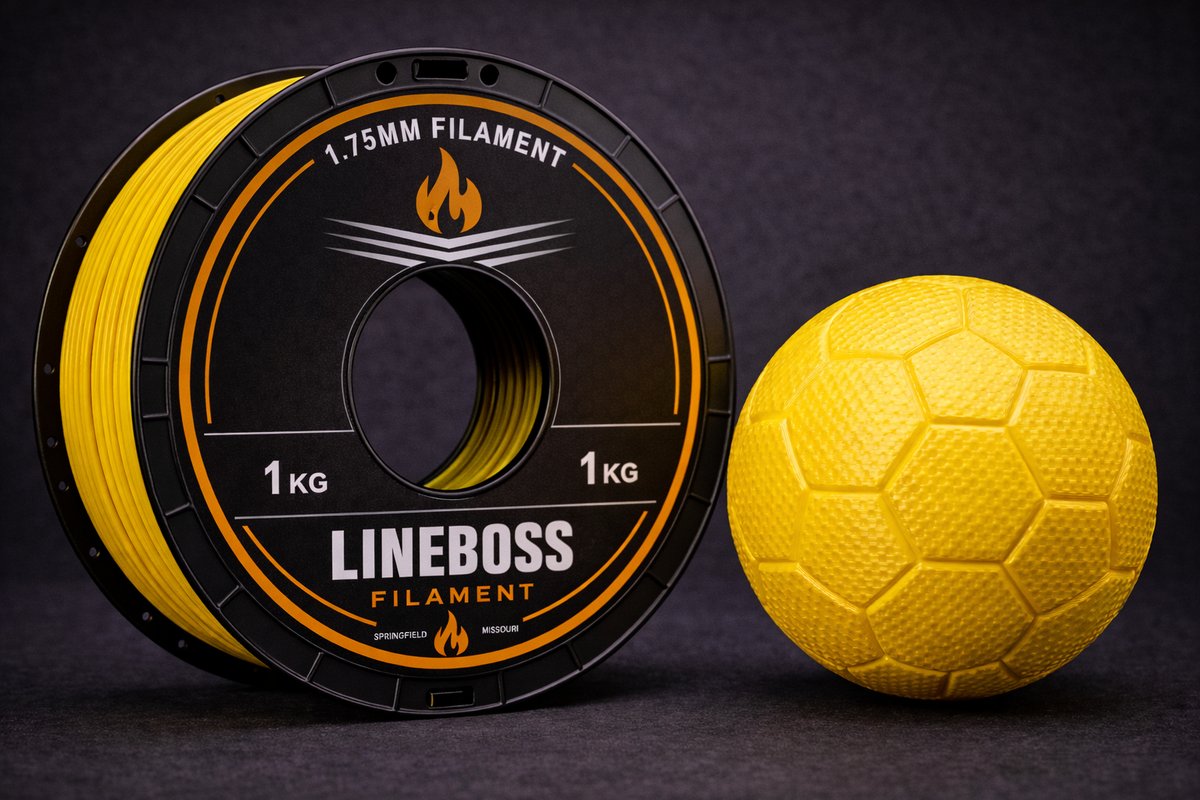
LineBoss Filament helps makers choose filament for the job. The catalog covers everyday materials, specialty finishes, and filled filaments, sold as individual spools or mixed bundles for volume savings. Spools are vacuum sealed with desiccant, and LineBoss provides practical setup support.
The challenge for any farm is simple: prove consistency before scaling. LineBoss answers that with a published ±0.02 mm tolerance, product-specific starting settings, and responsive help when a profile needs tuning. Browse the print farm and business essentials collection to stock reliable filament and drying gear for repeat production.
Get started with LineBoss Filament and build a filament shelf suited to your workload.
Frequently Asked Questions
What should a print farm look for in a filament supplier?
Look for documented diameter tolerance, sealed packaging with desiccant, and clear material guidance. LineBoss Filament lists a +/-0.02mm diameter tolerance and vacuum seals every spool. Also check printer compatibility, net spool weight, and return policy before committing to volume. A supplier that explains tradeoffs and helps you tune settings for your machines is more useful than one that only quotes a low price.
What is a good alternative to Atomic Filament for a print farm?
LineBoss Filament offers PLA, PLA+, PETG, PETG-CF, and ABS with a stated +/-0.02mm diameter tolerance and vacuum sealing. For farms running PETG, LineBoss PETG ($12.99 per 1 kg spool) is a practical starting point. Order a single spool first, run your own consistency checks, and confirm the material suits your parts before buying in bulk.
How can print farms compare filament consistency between brands?
Measure diameter at several points along each spool with calipers, print the same test part on multiple machines, and record extrusion behavior and layer adhesion. Weigh spools to confirm net material weight. Track failures per spool so you can see whether problems cluster around one batch. Consistent diameter and sealed packaging reduce the variables you have to chase.
How do you qualify a new filament for a print farm?
Start with one spool and a small test print on a single machine. Check diameter, print quality, and layer adhesion, then run the same job on a second printer to see whether results repeat. Record settings that worked, including temperature, flow, and retraction, and keep them for future batches. Only move to bulk ordering after the material passes your own tests.
