Material guide
Choosing Between PLA and PETG: A 2026 Guide
From planning to printing
Find material for your next print
Compare current colors, prices, and setup requirements before choosing a spool for your project.
Share this guide
Get the article link

Table of Contents
- PLA vs PETG: The Core Material Differences
- PLA vs PETG Strength: Stiffness, Impact, and Layer Adhesion
- PLA vs PETG Heat Resistance and Temperature Limits
- PLA vs PETG Outdoor Use and Long-Term Aging
- PETG Printing Settings: Nozzle, Bed, Speed, and Cooling
- A Decision Framework Based on Part and Failure Mode
- Food Contact, Chemical Safety, and Environmental Claims
- Conclusion
- Frequently Asked Questions
Last Updated: October 21, 2026
PLA vs PETG: The Core Material Differences
Choosing between PLA and PETG starts with one question: what will the part actually do? PLA and PETG are the two most common filaments in desktop FDM printing, and they fail in opposite ways. PLA is stiff and prints cleanly but snaps under sudden load. PETG bends before it breaks and handles heat and moisture better, at the cost of stringing and slower tuning.
What Each Filament Is Made Of
PLA (polylactic acid) is a polyester derived from plant-based feedstocks such as corn starch or sugarcane, and it prints at relatively low temperatures with minimal odor. LineBoss standard PLA is made from imported biodegradable raw materials and produces rigid, dimensionally stable parts with crisp detail.
PETG (polyethylene terephthalate glycol) is a copolyester: PET with glycol added to slow crystallization and improve printability. LineBoss PETG combines PLA-like ease of printing with ABS-like rugged strength, low warping, high impact resistance, and low shrinkage.

Quick Comparison Table
| Property | PLA | PETG |
|---|---|---|
| Stiffness / rigidity | High | Moderate |
| Impact resistance | Low (brittle, can snap) | High (flexes before breaking) |
| Heat resistance | Low | Moderate |
| Layer adhesion | Good | Excellent |
| Warping tendency | Very low | Low |
| Stringing tendency | Low | High |
| Moisture resistance | Poor | Good |
| Best for | Display, prototypes, detail | Brackets, jigs, outdoor parts |
PLA vs PETG Strength: Stiffness, Impact, and Layer Adhesion
PLA wins on stiffness. PETG wins on toughness. Those are different properties, and conflating them is the most common mistake in PLA vs PETG strength debates. A stiff part resists bending under load; a tough part absorbs impact without fracturing.
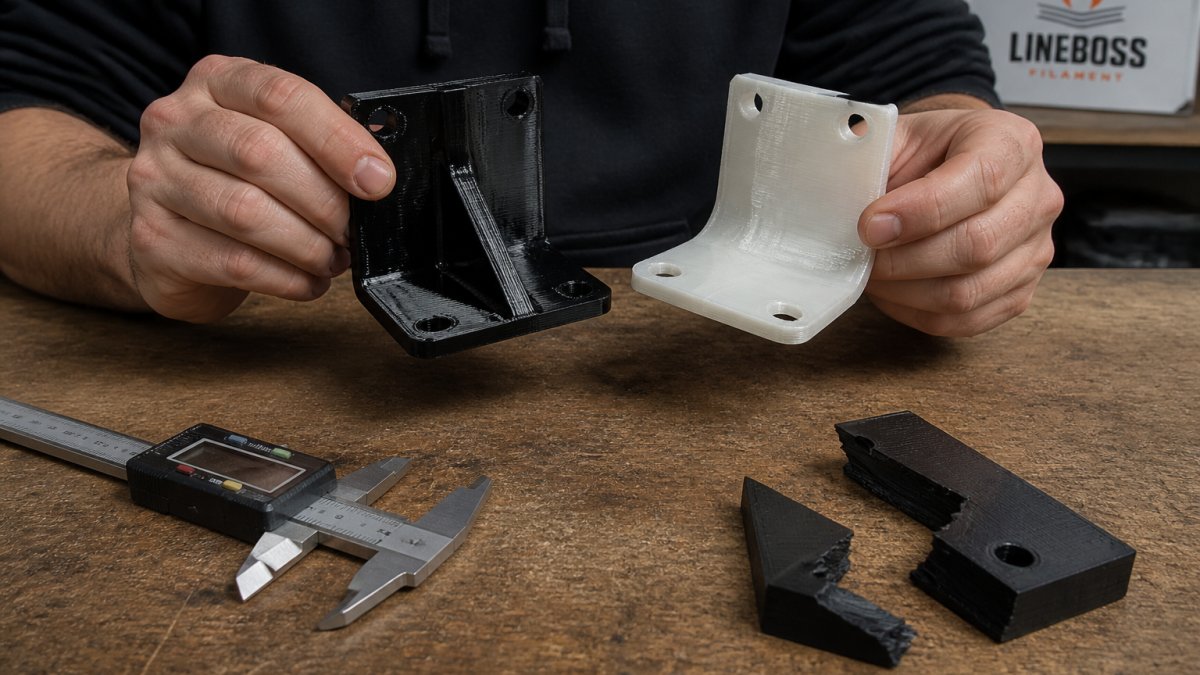
The mechanism explains the behavior. PLA is a semi-crystalline polyester whose polymer chains are relatively immobile at room temperature, giving it a high modulus (resistance to elastic deformation) but little capacity to dissipate energy. When stress exceeds its yield point, cracks propagate quickly and the part snaps.
Layer adhesion matters here too. PETG's longer, more mobile chains diffuse more readily and form a stronger interlayer weld, which is why functional PETG parts survive stress that delaminates PLA. Standard PLA layer bonding is good but more sensitive to cooling and print speed: aggressive part cooling freezes the interface before diffusion completes, and high print speeds shorten the time available for bonding.

Why Fair Strength Comparisons Are Harder Than They Look
Published strength numbers rarely translate between machines. Tensile test results depend on print orientation, layer height, nozzle temperature, flow rate, extrusion width, wall count, infill pattern, and even spool moisture.
A common mistake is comparing two filaments printed on different machines with different profiles, or comparing a datasheet tensile value (measured on a molded or solid specimen) against a printed part. The honest approach is to test on your own printer, with your own settings, using the same part geometry and orientation.
For starting profiles that keep layer adhesion consistent between the two materials, see the slicer settings guide.
PLA vs PETG Heat Resistance and Temperature Limits
PLA softens at lower temperatures than PETG, which decides most indoor-versus-outdoor calls. PLA's glass transition temperature sits well below PETG's, so a PLA part left in a hot car or direct summer sun can sag and lose shape.
For parts near heat sources, in vehicles, or outdoors, PETG is the safer default. For decorative pieces, models, and prototypes kept at room temperature, PLA's lower heat resistance rarely matters. Always check the material maker's published temperature guidance for your specific spool rather than relying on generic numbers.
PLA vs PETG Outdoor Use and Long-Term Aging
PETG is the better outdoor choice, but "outdoor use" covers a lot of ground. LineBoss PETG is described as water-resistant for outdoor use, making it suitable for garden fixtures, outdoor tools, and parts exposed to humidity.
Long-term aging is where claims get slippery. No desktop filament is permanently weatherproof, and parts under constant sun and load will change over months. Design for replacement: thicker walls, generous fillets, and mechanical fasteners instead of relying on printed threads.
PETG Printing Settings: Nozzle, Bed, Speed, and Cooling
PETG printing settings depend on your printer, hotend, extruder type, and the material maker's stated range, so treat any single number as a starting point. Start within the temperature range printed on your spool, then adjust in small steps. LineBoss publishes product-specific starting profiles to shorten that tuning loop.
Practical starting points for tuning, not universal values:
- Nozzle temperature: begin mid-range on the spool label, then adjust for layer adhesion and stringing
- Bed temperature: follow the maker's range; a slightly higher bed helps first-layer grip
- Print speed: slower than PLA, especially on perimeters, to improve bonding
- Part cooling: reduce fan compared with PLA; too much cooling hurts layer adhesion
- Retraction: tune per printer and hotend; PETG strings more than PLA
A Diagnostic Guide for PETG Problems
Most PETG frustration comes from four symptoms.
Stringing and fine hairs between parts. PETG's high melt viscosity and tackiness make it prone to oozing during travel.
Blobs and zits on the surface. These usually come from ooze during travel or from pressure buildup at the end of an extrusion.
Warping on large flat parts. PETG warps less than ABS but still lifts on big footprints.
Because every fix above depends on your extruder, hotend, and build surface, record what you change and in what order. To weigh filament use against failed prints during tuning, use the 3D printing cost calculator.
A Decision Framework Based on Part and Failure Mode
Pick the material by asking how the part will fail, not by which filament is "stronger." Use this framework:
- Does the part need to resist impact or flex? Choose PETG.
- Does the part sit near heat, in a car, or outdoors? Choose PETG.
- Does the part need maximum stiffness and crisp detail? Choose PLA.
- Is the part decorative, a prototype, or a display model? Choose PLA or Matte PLA.
- Will the part see sustained load? Avoid standard PLA; consider PLA+ or PETG.
For brackets, jigs, fixtures, organizers, and other functional prints, LineBoss PETG is the practical everyday choice. For decor, prototypes, toys, and art designs, LineBoss PLA delivers clean detail at lower print temperatures. Where impact resistance matters but PLA-style printing is preferred, LineBoss PLA+ adds impact modifiers so parts bend slightly before breaking.

| Part / Failure Mode | Recommended Material | Why |
|---|---|---|
| Shelf display model | PLA or Matte PLA | Stiffness, detail, low cost |
| Snap-fit clip | PLA+ or PETG | Needs flex before failure |
| Car interior part | PETG | Higher heat resistance |
| Garden bracket | PETG | Moisture and outdoor resistance |
| Prototype for fit check | PLA | Fast, dimensionally stable |
Food Contact, Chemical Safety, and Environmental Claims
Food contact and chemical safety claims deserve skepticism.
Chemical resistance follows the same logic. PETG generally resists many common chemicals better than PLA, but resistance depends on the specific chemical, concentration, and exposure time. Verify against the material maker's documentation rather than assuming.
Environmental claims need real-world context. PLA is often described as biodegradable, yet it biodegrades reliably only in industrial composting conditions, not a backyard or landfill.
Conclusion
The hardest part of choosing between PLA and PETG is resisting the urge to pick a winner in the abstract. Decide from the part: impact, heat, and moisture push you to PETG; stiffness, detail, and easy printing push you to PLA. LineBoss Filament stocks both, with +/-0.02mm diameter tolerance, vacuum-sealed spools with desiccant, and practical starting profiles to shorten tuning. Compare the PLA and PETG listings, or run the numbers with the 3D printing cost calculator before committing to a spool.
Frequently Asked Questions
What is the main difference between PLA and PETG?
PLA is a rigid, easy-printing filament that produces crisp detail but snaps under high stress and softens at lower temperatures. PETG prints with PLA-like ease but behaves more like ABS in use: it resists impact, bonds well between layers, and handles heat and moisture better. That trade-off is the whole decision. If your part is decorative or a prototype, PLA is simpler. If it is a bracket, jig, or outdoor fixture, PETG usually wins. LineBoss stocks both at $12.99 so you can test the same model in each.
Is PETG stronger than PLA?
In impact and layer adhesion, generally yes. PETG flexes before breaking, while standard PLA can snap suddenly under stress. In stiffness, PLA is the stiffer material, so a PLA part may deflect less under a steady load until it fails. That is why PLA vs PETG strength depends on the failure mode: a part that gets dropped or pried favors PETG, while a part that must hold shape under light load can do fine in PLA. LineBoss PLA+ adds impact modifiers for a middle ground at $14.99.
Which is easier to print, PLA or PETG?
PLA is more forgiving. It prints at lower nozzle temperatures, needs less part cooling tuning, and rarely strings badly. PETG is still beginner-friendly but demands more attention: it is stickier, so it strings more, and it bonds aggressively to some build surfaces. It also prefers slower speeds and less part cooling fan than PLA. Neither is difficult on a modern printer. Start with the manufacturer's recommended temperature range for your spool, then adjust flow and fan speed for your specific machine.
Is PLA or PETG better for outdoor use?
PETG is the better default for outdoor parts. It resists moisture and handles sun-driven heat better than standard PLA, which can soften and deform in a hot car or direct summer sun. PETG is not immune either: sustained UV exposure degrades most thermoplastics over time, and color fading is common. For long-term outdoor duty, plan for replacement or consider an ASA or UV-stabilized material. For a season or two of light outdoor use, PETG covers most brackets, planters, and garden fixtures well.
Which filament handles heat better, PLA or PETG?
PETG handles heat better. Standard PLA has a low glass transition temperature and can soften well below the temperatures a PETG part tolerates, which is why a PLA print left in a hot car may sag. PETG holds its shape at higher temperatures but still has a ceiling, so check the spool's data sheet for the exact figure rather than assuming. Neither material suits engine bays or hot-water contact. If heat is the primary requirement, look at engineering-grade filaments instead.
Can you print PLA and PETG on the same 3D printer?
Yes, with one caution: the two materials do not bond to each other. If you switch from PLA to PETG, purge thoroughly and avoid leaving PLA residue in the hotend, because leftover PLA can cause clogs at PETG temperatures. Clean the nozzle and, if your printer allows, run a short purge at PETG temperature before starting. Do not design parts that rely on a PLA-to-PETG joint holding under load. A dual-material print with these two is fine for visual contrast, not structural bonding.
When should I choose PLA instead of PETG?
Choose PLA for display models, prototypes, toys, art pieces, and light-duty household items where crisp detail and easy printing matter more than toughness. PLA also wins when dimensional accuracy on fine features is the priority, and it is cheaper to iterate with. LineBoss Matte PLA at $13.99 hides layer lines well on display pieces. Skip PLA for anything that will sit in a hot car, take repeated impacts, or live outdoors. For those, step up to PETG or PLA+.
How should I store PLA and PETG filament?
Keep both sealed with desiccant when not in use. PETG absorbs moisture more readily than PLA, and wet PETG prints with popping, stringing, and weak layer adhesion, so drying before a long print is worth the time. Store spools in an airtight container with fresh desiccant and keep them out of direct sun. LineBoss spools ship vacuum sealed with desiccant, which gives you a clean starting point. Re-seal partially used spools the same day you open them.