Material guide
5 Polymaker Alternatives for Functional Parts That Hold Up
From planning to printing
Find material for your next print
Compare current colors, prices, and setup requirements before choosing a spool for your project.
Share this guide
Get the article link

Last Updated: November 4, 2026
Quick Summary
The best polymaker alternative for functional parts depends on the failure mode: PETG is the balanced default for brackets, jigs, and fixtures, while PLA+ suits prototypes and ASA handles sun-exposed outdoor use. Match your functional parts filament to strength, heat, and weather needs rather than brand name.
- PETG is listed at $12.99 and recommended for brackets, jigs, fixtures, and organizers.
- PLA+ costs $14.99 and fits prototypes and fit checks with improved toughness.
- ASA at $18.99 offers UV and weather resistance for outdoor-facing parts.
- ABS and TPU are each $17.99, with ABS for heat and TPU for flex and rebound.
- ABS and ASA benefit from an enclosure, controlled cooling, and ventilation.
Table of Contents
- What to Compare When Choosing a Polymaker Alternative for Functional Parts
- 3D Printer Filament Types and Uses for Functional Parts
- The Best Filament for Functional Parts by Application
- PETG vs PLA for Functional Parts: Which One Should You Print?
- Part Design and Print Orientation: Where Functional Prints Actually Fail
- Cost, Equipment, and Safety: The Hidden Requirements of Functional Filament
- Choosing Your Functional Filament and Starting Your First Print
- Frequently Asked Questions
What to Compare When Choosing a Polymaker Alternative for Functional Parts
Shopping for a polymaker alternative for functional parts comes down to matching material properties to the job, not chasing a brand name, and the right functional parts filament should hold up under load. This guide compares LineBoss PETG, PLA+, ABS, ASA, and TPU filaments against the requirements that decide whether a part survives. The right functional parts filament should hold up under load, resist the environment it lives in, and print predictably on the machine you own. Below, each option is matched to specific applications so the choice stops being guesswork.
Mechanical Requirements: Strength, Toughness, and Stiffness
Three properties drive most failures. Strength is how much load a part carries before it breaks. Toughness is how much it bends and absorbs impact before cracking. Stiffness is how little it flexes under load. A bracket needs stiffness and strength; a bumper needs toughness. PLA+ sits at the stiff end, PETG balances strength with impact resistance, and TPU trades stiffness for flex and rebound. Pick the property the part actually needs, because no single filament maximizes all three.
Environmental Requirements: Heat, UV, Moisture, and Chemicals
Indoor parts rarely care about weather. Outdoor parts care about all of it. ASA offers UV and weather resistance for sunlight, rain, and harsh climates, while PETG brings water resistance for outdoor tools. ABS delivers high temperature resistance for warmer environments. Standard PLA softens in a hot car, so it belongs indoors. If a part lives on a porch, a dashboard, or a garden bed, environmental resistance outranks raw strength in the decision.
3D Printer Filament Types and Uses for Functional Parts
Each filament family solves a different problem, and knowing the mechanism behind each family makes selection faster than comparing spool by spool. The notes below describe how each material behaves and where it tends to fail, so you can match the family to the job before you open a slicer profile.
PLA and PLA+: Stiff, Easy, and Brittle by Default
Standard PLA is stiff and prints easily, but it is brittle and softens at relatively low temperatures, so it belongs indoors and away from heat. PLA+ (also sold as PLA Pro or tough PLA) blends in impact modifiers that let the part bend slightly before it cracks. That improves toughness without changing the underlying stiffness, so PLA+ is a good fit for prototypes, fit checks, and light-duty brackets that never see heat or sustained load. It is not a substitute for an engineering resin when a part carries load over time.
PETG: The Balanced Workhorse
PETG is a glycol-modified PET material that combines PLA-like ease of printing with ABS-like strength, low warping, high impact resistance, and excellent layer adhesion, and its listing describes it as water-resistant for outdoor use. For brackets, jigs, fixtures, and outdoor tools that see handling rather than heat, it is the default choice.
ABS and ASA: Heat and Weather, With Chamber Demands
ABS delivers higher heat resistance and toughness than PLA or PETG, which suits enclosures, mounts, and parts near warm equipment. ASA adds superior UV and weather resistance, making it a fit for UV-aware outdoor-facing parts. ABS and ASA benefit from an enclosure, controlled cooling, and ventilation.
TPU: Flex and Rebound
LineBoss TPU has 95A +/-2 Shore hardness with strong rebound, wear resistance, and excellent flexibility. A controlled filament path and slow printing are recommended.
Filled Filaments: Stiffness at a Hardware Cost
Carbon-fiber and glass-fiber filled filaments embed short fibers in a base polymer, which raises stiffness and reduces warping compared with the unfilled version. The fibers are abrasive, so they wear brass nozzles quickly; a hardened steel or ruby nozzle is the usual mitigation. Filled filaments also need larger nozzle openings to avoid clogs and produce dust when sanded, so handle post-processing with appropriate respiratory protection. They add stiffness, not toughness, so do not expect a filled part to absorb impact better than the unfilled base material.
Matching the Family to the Failure Mode
The fastest way to choose is to name how the part is most likely to fail. If it will soften in heat, move up to ABS or ASA. If it will crack on impact, move from PLA toward PETG or TPU. If it will creep under a sustained load, favor stiffness and consider a filled grade. If it will sit in sunlight, ASA is the starting point. That failure-mode framing is more reliable than picking the material with the highest single number on a datasheet.
The Best Filament for Functional Parts by Application
The table below maps common functional jobs to the LineBoss material listed for that use.
| Application | Recommended Filament | Why It Fits | Price |
|---|---|---|---|
| Brackets, jigs, fixtures | PETG | Strength, layer adhesion, low warping | $12.99 |
| Prototypes and fit checks | PLA+ | Easy printing, improved toughness | $14.99 |
| Outdoor and sun-exposed | ASA | UV and weather resistance | $18.99 |
| Hot environments, enclosures | ABS | High temperature resistance | $17.99 |
| Grips, feet, bumpers | TPU | Flex, rebound, wear resistance | $17.99 |
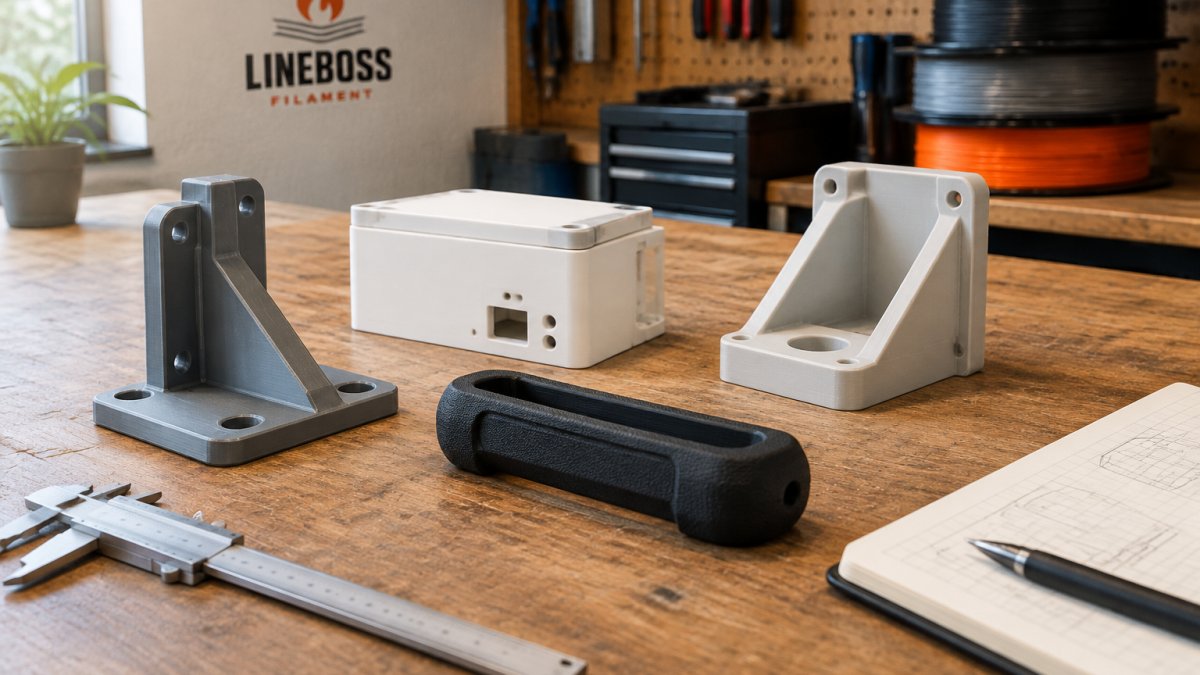
Brackets, Jigs, and Fixtures
PETG is the LineBoss listing's recommended material for brackets, jigs, fixtures, and organizers, combining PLA-like ease of printing with low warping and strong layer adhesion.
Outdoor and Heat-Exposed Parts
ASA offers superior UV and weather resistance and is suited to UV-aware outdoor-facing parts. PETG is water-resistant for outdoor use. For a deeper comparison, see Best Filament for Outdoor Garden Parts: ASA vs PETG.
Flexible and Wear-Resistant Parts
TPU covers anything that needs to bend, grip, or absorb shock. At 95A shore hardness it balances elasticity with toughness, which suits phone cases, insoles, watch bands, robotics parts, and bumpers. Print it slowly with a controlled filament path. For more on flex behavior and impact absorption, read TPU, For Flex, Grip, and Impact Absorption.
PETG vs PLA for Functional Parts: Which One Should You Print?
PETG combines strength, impact resistance, and water resistance, and is listed as suited to brackets, jigs, and outdoor tools. PLA+ adds improved toughness with easy, beginner-friendly printing and an impact-modified formula that can bend slightly before breaking. See PETG, The Functional Middleweight Champion for more on PETG.
Part Design and Print Orientation: Where Functional Prints Actually Fail
Part orientation affects how a functional print performs under load, so consider how layers align with the force the part will carry. For practical fixes, see How to Improve Layer Adhesion on Your 3D Prints.
Cost, Equipment, and Safety: The Hidden Requirements of Functional Filament
Spool price is only part of the cost of a functional part, and equipment and handling requirements also affect the total. This section breaks down the total-cost drivers, the hardware each material demands, and the handling steps that keep a shop safe. None of these replace the material maker's own published limits; they are the practical requirements that sit around those limits.
Total Cost Beyond Price per Kilogram
A fair comparison counts filament used per part, failed-print risk, nozzle wear, drying, enclosure energy, and post-processing time. A material that prints reliably on the first attempt can cost less per finished part than a cheaper spool that fails twice. To estimate filament cost per part, use the 3D printing cost calculator with your own part weight and infill. Then add the non-filament costs: a hardened nozzle for filled filaments, a filament dryer for hygroscopic materials, and the electricity an enclosure draws to hold chamber temperature. Those line items often exceed the difference between two spool prices.
Equipment Requirements by Material
- ABS and ASA: an enclosure, controlled cooling, and ventilation are recommended; LineBoss can help with setup.
- TPU: print slowly with a controlled filament path; LineBoss can help establish a stable starting profile.
Drying and Moisture Control
LineBoss spools are vacuum sealed with desiccant for moisture-free storage. Follow the material maker's published drying guidance where needed.
Safety and Handling
- Ventilation: print ABS and ASA in a ventilated space, and check the [Occupational Safety and Health Administration guidance on ventilation | osha.gov] for workspace airflow.
Slicer Settings and Profile Starting Points
Material makers publish temperature ranges for their own products, and those limits should guide your profile rather than a copied number from a forum. Retraction distance and speed depend on your extruder, hotend, and filament path, so there is no universal value; tune from the maker's range and your hardware. For profile starting points, see the slicer settings guide. Use the material maker's published temperature range as the reference for your profile.
Choosing Your Functional Filament and Starting Your First Print
Start with the application, then the environment, then the printer. PETG is listed at $12.99, PLA+ at $14.99, ABS and TPU at $17.99 each, and ASA at $18.99. LineBoss Filament vacuum seals its spools with desiccant and lists a +/-0.02mm diameter tolerance. Browse the full functional and engineering filament lineup to match a material to your next part, and plan to tune the profile for your machine.
Frequently Asked Questions
What should I compare when choosing a Polymaker alternative for functional parts?
Start with the mechanical demands of the part: strength, toughness, stiffness, and impact resistance. Then check environmental exposure, including heat, UV, moisture, and chemicals. Confirm your printer can handle the material, since ABS and ASA usually need an enclosure and ventilation. Finally, compare cost per kilogram and how consistently the filament diameter holds. The filament's 1.75 mm diameter is listed with a +/-0.02mm tolerance.
Is PETG or PLA better for functional prints?
PETG is usually the better choice for functional parts that see load, impact, or moisture. It is stronger than PLA, more impact resistant, and water resistant, which suits brackets, jigs, and outdoor tools. PLA and PLA+ print with ease and suit prototypes, fit checks, and light-duty household parts. PLA+ adds impact modifiers that let a part bend slightly before breaking.
Which filament is best for parts exposed to heat or impact?
For heat exposure, ASA and ABS are the usual picks because they tolerate higher temperatures than PLA or PETG. ASA adds UV and weather resistance, so it suits outdoor-facing parts. For flexible parts, TPU at 95A shore hardness suits grips, feet, and bumpers. Match the material to the actual load and temperature the part will see rather than picking the stiffest option.
What is the best filament for functional parts on a printer without an enclosure?
PETG and PLA+ are common starting points for an open-frame printer. PETG prints with low warping and strong layer adhesion, and PLA+ is beginner-friendly with improved toughness over standard PLA. ABS and ASA generally need an enclosure, stable chamber temperature, and ventilation to reduce cracking and warping on large prints. If you print functional parts on an open printer, start with PETG and tune temperature and flow before moving to engineering materials.
How much does functional filament cost per kilogram?
LineBoss prices its 1 kg spools at $12.99 for PETG, $14.99 for PLA+, $17.99 for ABS and TPU, and $18.99 for ASA. LineBoss offers free U.S. shipping over $50.
The gap between a part that lasts and one that cracks usually comes down to one material decision made before the first layer. LineBoss Filament supports that choice with vacuum-sealed spools, product-specific setup help, and practical starting profiles for each material. Get started with LineBoss Filament and print functional parts with a material matched to the job.
