Material guide
Food-Safe Coating Options for PLA 3D Prints
From planning to printing
Check the material requirements first
Read the application limits in this guide before selecting filament. A product link is not a food-contact or dishwasher-safety certification.
Share this guide
Get the article link

Last Updated: November 12, 2026
Quick Summary
A food-safe coating closes the porous, layered surface of a PLA print so food particles and moisture cannot collect in the seams. Epoxy, polyurethane, silicone, and shellac are the common options, and each must carry food-contact documentation for the exact product. No coating changes the fact that PLA softens at modest temperatures.
- A finished PLA print is not automatically food safe, because layer porosity traps residue that rinsing cannot reach.
- Epoxy gives the hardest, smoothest film and hides layer lines, but it is brittle if the part flexes.
- Silicone handles heat best of the group, but adhesion to smooth PLA is its weak point.
- Shellac is a quick seal for dry goods only; it wears through fast and dissolves in alcohol.
- Check the technical data sheet for the exact SKU, intended food-contact use, full cure schedule, and service temperature.
Table of Contents
- What Food-Safe Means for a PLA 3D Print
- Is PLA Food Safe for 3D Printing?
- Comparing Food-Safe Resin Coating for 3D Printing Options
- Choosing a Food-Safe Sealer for 3D Prints
- Is PETG Food Safe for 3D Printing?
- A Reproducible Coating and Curing Protocol
- Verifying Food-Contact Claims and Documentation
- Coating Wear, Failure, and Reapplication
- Frequently Asked Questions
What Food-Safe Means for a PLA 3D Print
A food-safe 3D print is one whose surface will not transfer harmful substances to food and can be cleaned thoroughly between uses, which is why a food-safe coating matters.
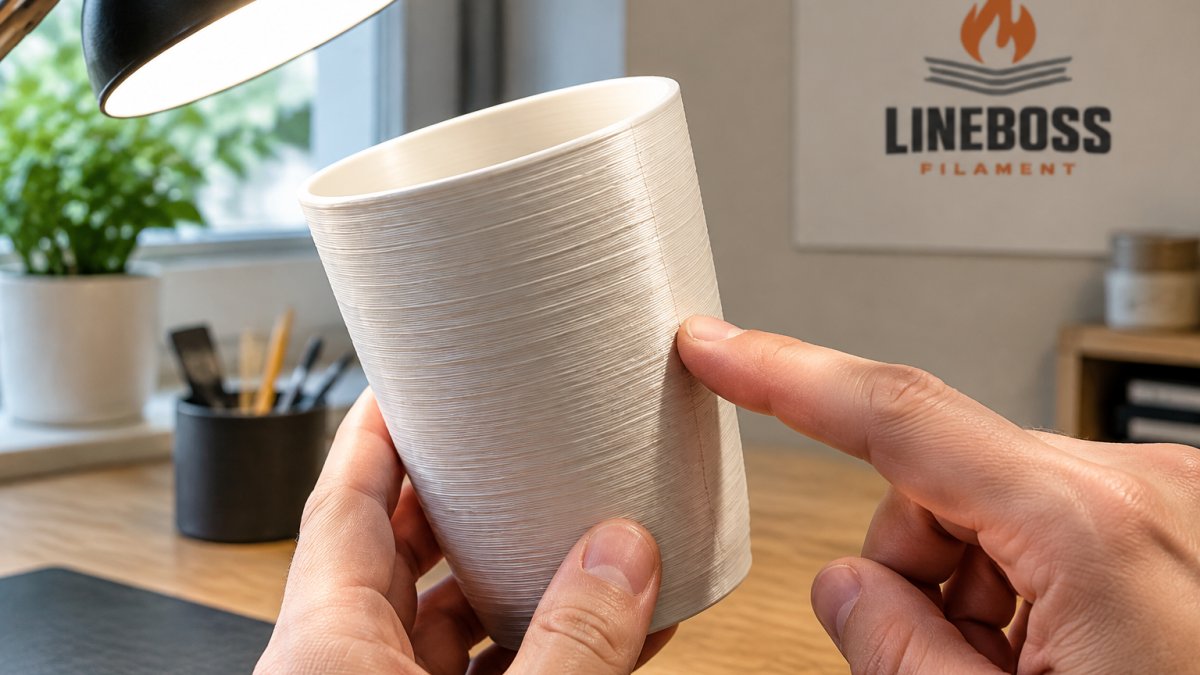
FDM printing builds parts in layers that never fuse into a seamless skin.
So a food-safe coating has one job: close the surface completely. Everything else in this guide follows from that.
Layer Lines, Porosity, and Where Contamination Collects
Contamination collects in three predictable places: layer seams on vertical walls, top surface infill gaps, and any crevice where two printed features meet. A part can look smooth and still hold a film of residue in all three.
Layer adhesion quality directly affects how open those seams are; weak interlayer bonding means wider gaps that trap more. If seams are the concern, review the practical fixes for layer adhesion before any coating goes on.
Is PLA Food Safe for 3D Printing?
Plain PLA filament is generally regarded as safe in its solid form, but a finished PLA print is not automatically food safe.
Three things push a print out of food-contact use: layer porosity, colorants and additives of unknown composition, and nozzle material. A coating addresses only the first.
There is also a heat problem. PLA softens at modest temperatures, so a coated PLA part should not go into a dishwasher or hold hot liquid.
For a direct comparison of how PLA and PETG behave in food-adjacent roles, see choosing between PLA and PETG.
Comparing Food-Safe Resin Coating for 3D Printing Options
No single coating wins on every count.
| Coating | Food-contact documentation to look for | Cure requirements | Flexibility | Heat tolerance | Repeated washing |
|---|---|---|---|---|---|
| Epoxy resin | A statement of food-contact suitability for the exact product, plus a full cure schedule | Two-part mix by weight or volume; full cure often measured in days at room temperature | Low; brittle if flexed | Moderate; check the product's stated service temperature | Good once fully cured, but chips at edges |
| Polyurethane | Food-contact claim for the specific SKU; some are marketed for incidental contact only | Two-part or moisture-cure; multiple thin coats | Moderate to high | Moderate; varies widely by product | Good, but thins gradually with abrasion |
| Silicone | Food-contact grade documented for the intended use (some are mold-making grades, not coating grades) | One-part moisture-cure or two-part addition-cure; full cure can take a day or more | High | High; often the best of the group | Good, but adhesion to smooth PLA is the weak point |
| Shellac | Food-contact grade (some shellac is sold as wood finish, not food-contact) | Solvent evaporation; recoatable quickly | Low | Low; softens with heat | Poor; wears through quickly |
Epoxy gives the hardest, smoothest film and hides layer lines well, making it the strongest choice for a rigid box or tray.
Polyurethane stays slightly flexible, so it survives drops and minor deformation without cracking, though expect to build the film in several thin coats.
Silicone handles heat better than the other two and suits flexible prints, but adhesion to bare PLA is the weak point and the film can peel at edges. Many silicone products sold for craft use are mold-making grades, not coating grades, so confirm the product is documented for the application.
Shellac is the traditional quick seal for dry goods. It is not a wet-contact coating and it wears through quickly.
Epoxy, Polyurethane, and Silicone Side by Side
Judge the three on hardness, flexibility, heat tolerance, repairability, and the strength of the product's food-contact documentation. Epoxy wins hardness and repairability, polyurethane wins flexibility, and silicone wins heat but loses on adhesion and repair.
A common mistake is picking epoxy for a part that will flex every time it is used; the film cracks at the stress point, and the crack becomes the contamination trap the coating was meant to prevent.
Matching the Coating to the Food-Contact Use Case
The coating choice should follow the use case, not the other way around. Dry, brief-contact uses (a cookie cutter, a dry-goods scoop) tolerate a thinner, less durable film. Cold or brief wet contact (a rinsed measuring cup) needs a fully cured film that can take light abrasion. Hot, acidic, fatty, or long-term storage uses are where PLA itself becomes the limiting factor: PLA softens at modest temperatures, and no coating chemistry changes that.
What the Documentation Should Tell You
Before trusting any coating for food contact, check the technical data sheet for four things: the exact product name and SKU the claim applies to, the intended food-contact use (direct vs. incidental, repeated vs. single-use), the full cure schedule, and any stated service temperature. Two resins from the same brand can carry different approvals, so if the data sheet does not state food-contact suitability for the product in hand, treat the coating as undocumented for that use.
Choosing a Food-Safe Sealer for 3D Prints
Pick the food-safe sealer for 3D prints by matching it to the part's job, not to its look.
Start with the application. Dry storage favors shellac or epoxy. Wet or repeated washing favors a fully cured epoxy or polyurethane.
Then check the product's own documentation for food-contact suitability.
Finally, plan for wear. Any film on a printed part will scratch.
Is PETG Food Safe for 3D Printing?
PETG sits in the same position as PLA: the raw polymer is generally regarded as safe, but the printed surface is not automatically food safe.
It does not solve porosity. PETG prints with the same layer seams, and it can string and leave blobs that create new crevices. A coating is still the step that makes the surface cleanable.
For makers weighing the switch, LineBoss PETG filament is available in 22 colors for durable parts, jigs, and everyday functional printing. Browse the PETG filament range to match a color and spool size to the project.
A Reproducible Coating and Curing Protocol
Consistency comes from controlling five variables: surface prep, mix ratio, coat thickness, bubble removal, and cure conditions. Change one at a time and record what worked. The steps below are a framework; the product manufacturer's instructions override any step here where they differ.
- Sand progressively. Work through grits fine enough to remove visible layer ridges, then finish with a light pass that leaves a uniformly dull surface. A glossy spot means the coating has nothing to key into there.
- Clean and dry fully. Wipe with isopropyl alcohol and let the part dry completely; any dust or moisture left behind becomes a bond failure under the film.
- Mix to the stated ratio. Measure two-part coatings by the ratio the maker states, by weight or by volume as specified. Stir slowly and steadily to limit bubbles.
- Apply a thin first coat. Brush along the layer direction so the film fills seams rather than bridging them; a thin coat releases bubbles more readily than a thick one.
- Remove bubbles before the film sets. Pass a heat source briefly over the wet film only if the product's instructions permit it, or drag a brush tip through visible bubbles. Trapped bubbles become pinholes that break the seal.
- Respect the recoat window. Let the first coat reach its stated handling stage before adding the second; too early can trap solvent, too late can prevent intercoat adhesion.
- Cure at the specified temperature for the full stated time. A tacky surface after the stated cure means the ratio or cure conditions were off. Handling time is not full cure.
- Inspect before use. Look for pinholes, thin spots at edges, and any area where the film did not wet out. A visual pass is not a food-safety test, but it catches application defects.
Watch out: coating a part that still holds moisture traps that moisture under the film, and the coating can lift. Dry the part fully first, following the filament maker's drying guidance.
Slicer settings affect how much surface you have to cover. The slicer settings resource covers the variables worth checking before printing a part destined for coating, and the 3D printing cost calculator can help account for coating and rework in the project budget.
Coating Failure, Wear, and Reapplication
Every coating fails eventually; the useful question is how it fails and whether it can be redone.
Reapplication follows the same logic: sand back to a sound surface, clean, and recoat. A part that has failed in the same spot twice is telling you the coating is wrong for that use, not that the application was poor.
For parts headed into wet or washing conditions, the guidance on dishwasher-safe filament choices covers which base materials hold up and where coatings fit in.
Verifying Food-Contact Claims and Documentation
A coating is only as good as its paperwork. Ask for the specific product's documentation before trusting a food-contact claim.
- Does the manufacturer state food-contact suitability for this exact product?
- Is there a written cure schedule, and does the label match it?
- Is the mixing ratio stated by weight, by volume, or both?
What most guides miss is that a supplier's general reputation says nothing about a specific SKU. Two resins from the same brand can carry different approvals.
LineBoss Filament distinguishes confirmed product specifications from general recommendations, and the team answers material and documentation questions directly. Contact the team with the printer and project details for help.
Coating Wear, Failure, and Reapplication
For parts headed into wet or washing conditions, the guidance on dishwasher-safe filament choices covers which base materials hold up and where coatings fit in.
Choosing a coating is really a decision about how a part will be used, cleaned, and repaired over its life. LineBoss Filament supplies PLA, PETG, TPU, and engineering-grade filaments with tight diameter tolerances and vacuum sealing, plus product-specific setup support when a print needs tuning.
Frequently Asked Questions
What can I coat PLA with to make it food safe?
The common choices are epoxy resin, polyurethane, silicone coating, and shellac. Each seals layer lines differently and each has tradeoffs: epoxy gives a hard, smooth surface but can crack if the part flexes; silicone stays flexible but is softer and wears faster; shellac is easy to apply but dissolves in alcohol and hot liquids. No coating makes a printed part permanently food safe. Pick the coating to match how the part will be used, and check the product's own documentation for food-contact claims before you rely on it.
Is a food-safe coating enough to seal the layer lines on a 3D print?
Only if the coating fully covers the surface and stays intact. Layer lines and surface porosity give food particles and bacteria places to collect, so a thin or patchy coat leaves gaps. Apply at least two thin coats, let each cure per the product instructions, and inspect for pinholes and missed spots. A food-safe sealer for 3D prints works best on a part that was printed with tight layer adhesion and a clean surface to begin with. Recoat when you see scratches or dull, worn areas.
Does epoxy resin make a PLA 3D print food safe?
Epoxy can seal the surface, but it does not automatically make the part food safe. Food-safe resin coating for 3D printing depends on the specific product: check that the maker states food-contact suitability for the fully cured resin, not the liquid. Cure time and mix ratio matter, because an under-cured epoxy can leave unreacted components. Epoxy also bonds poorly to flexing PLA and can chip at edges. Treat it as one option among several and verify the documentation first.
Is PETG food safe for 3D printing, and is it better than PLA for food contact?
PETG has better heat and moisture resistance than PLA, which matters for items that get washed. That does not make either material food safe on its own. Both are printed in layers that trap particles, and both need sealing if the part will touch food. PETG's higher printing temperature and tougher surface can make it a more durable base for a coating, but the coating and its cure still decide the outcome. Match the material to the part's temperature, cleaning, and durability needs, then seal and verify.
