Material guide
Best Filament for Dishwasher Safe 3D Prints
From planning to printing
Check the material requirements first
Read the application limits in this guide before selecting filament. A product link is not a food-contact or dishwasher-safety certification.
Share this guide
Get the article link

Last Updated: November 3, 2026
Quick Summary
The best filament for dishwasher safe 3D prints is polycarbonate, which has the highest glass transition temperature on our shortlist and the strongest heat tolerance, though it is the most demanding to print. ABS and ASA are plausible candidates for rigid parts, while PLA is not suitable and PETG is only marginal.
- Judge each filament against the hottest phase of the cycle, since heated drying often exceeds a material's glass transition temperature.
- PLA's glass transition temperature sits near or below the wash-water range, so it is not a candidate for repeated cycles.
- ABS and ASA generally need an enclosure, stable chamber temperature, and ventilation to print well.
- Test the actual printed part, not a coupon, and inspect it after each of five cycles.
- A coating that survives a wash does not upgrade the plastic underneath or fix a material that cannot take the cycle.
Table of Contents
- What Makes a Filament Dishwasher Safe
- Filament Comparison for Dishwasher Cycles
- Is PETG Filament Dishwasher Safe?
- Is PLA Food Safe for 3D Printing?
- Higher-Heat Alternatives: ABS and ASA
- Food-Safe Coating for 3D Prints
- Best Food-Safe Filament for 3D Printing
- Testing a Printed Part Before It Goes in the Dishwasher
- Frequently Asked Questions
What Makes a Filament Dishwasher Safe
Finding the best filament for dishwasher safe 3D prints is a heat problem first and a chemistry problem second. A part survives a dishwasher cycle when its material stays below its softening point through the wash and, just as importantly, through the heated drying phase.
Two separate questions get tangled together here. One is whether the plastic can take the heat. The other is whether the finished part is safe around food. A material passing the first test says nothing about the second.
Heat Resistance and Glass Transition Temperature
Glass transition temperature (Tg) is the point where a polymer shifts from a rigid, glassy state into a softer, rubbery one. Above Tg, a printed part loses stiffness, creeps under load, and distorts. For dishwasher use, Tg is the number that matters most, and it is why amorphous filaments like PLA struggle while semi-crystalline ones hold up better.
Dishwasher Temperature and Wash-Cycle Conditions
A dishwasher is a hostile environment in three ways at once. Hot water sprays the part from multiple angles. Detergent raises the chemical load. Heated drying pushes air temperatures well above the wash water. A part that shrugs off a warm rinse can still sag during the dry cycle, so judge a filament against the hottest phase, not the average.
Filament Comparison for Dishwasher Cycles
The practical shortlist for the best filament for dishwasher safe 3D prints is short. Semi-crystalline and higher-Tg materials come closest; commodity PLA does not. The table below summarizes how the common families behave, based on published material characteristics.
| Material | Typical Tg (published) | Heat Behavior | Detergent Resistance | Printability | Dishwasher Outlook |
|---|---|---|---|---|---|
| PLA | Roughly 55-60 °C | Low Tg, softens early | Moderate | Very easy | Not suitable |
| PETG | Roughly 75-80 °C | Moderate heat tolerance | Good | Easy | Marginal, test first |
| ABS | Roughly 100-105 °C | Higher heat tolerance | Good | Needs enclosure | Plausible for rigid parts |
| ASA | Roughly 100-105 °C | Higher heat tolerance | Good | Needs enclosure | Plausible, UV-stable |
| Nylon | Grade-dependent, often 45-90 °C | Good heat tolerance | Varies by grade | Moisture-sensitive | Grade-dependent |
| Polycarbonate | Roughly 145-150 °C | High heat tolerance | Good | Demanding | Strongest candidate |
Read that table as a starting filter, not a verdict. Print settings, wall count, infill, and part geometry change real-world performance more than the material label alone.
Matching Materials to Wash and Dry Phases
Dishwasher safety is not one threshold. A typical residential cycle runs a pre-wash, a main wash, one or more rinses, and a heated dry phase, and the air temperature during heated drying is the phase that most often exceeds a filament's Tg. Published Tg values are a useful screen, but they are measured under dry conditions; hot water, detergent, and sustained load lower the effective ceiling.
A practical way to compare materials is to judge each one against the hottest phase it will actually see, not the average cycle temperature:
- PLA: Its Tg sits near or below the wash-water range on many cycles, so even the wash phase can soften it. Heated drying removes any remaining margin. Not a candidate for repeated cycles.
- PETG: Tg is above typical wash water but close enough to heated-dry air that thin sections and tall features distort first. Parts with thick walls, low profiles, and rigid geometry have the best chance; test before trusting.
- ABS and ASA: Tg is well above wash and rinse temperatures, so the main risk shifts to the dry phase and to layer bonding. A well-bonded, enclosed-chamber print is a plausible candidate; a poorly bonded one fails regardless of material.
Cycle-by-Cycle Durability and Long-Term Aging
Most brief answers stop at whether a material can tolerate heat once. Repeated washing is a different question. Detergent exposure, hot water, and drying cycles accumulate stress, and gradual degradation shows up as surface crazing, dimensional drift, and layer separation rather than a single dramatic failure. A part that survives one cycle is not the same as a part that survives fifty.
Printability Trade-offs
Choosing realistically means matching the material to the printer you actually have. PLA and PETG run on open-frame desktop printers. ABS and ASA generally need an enclosure, stable chamber temperature, and ventilation. Polycarbonate is the most demanding: high temperatures, drying, and an enclosure are typical prerequisites. Check the LineBoss ABS and ASA filament product pages for specs before committing, and use the slicer settings resources to understand the parameters that affect layer bonding.
Is PETG Filament Dishwasher Safe?
PETG is not generally rated dishwasher safe, though it is the most forgiving of the easy-printing filaments. PETG handles heat better than PLA and resists moisture and many detergents, but heated drying cycles push it toward its softening range.
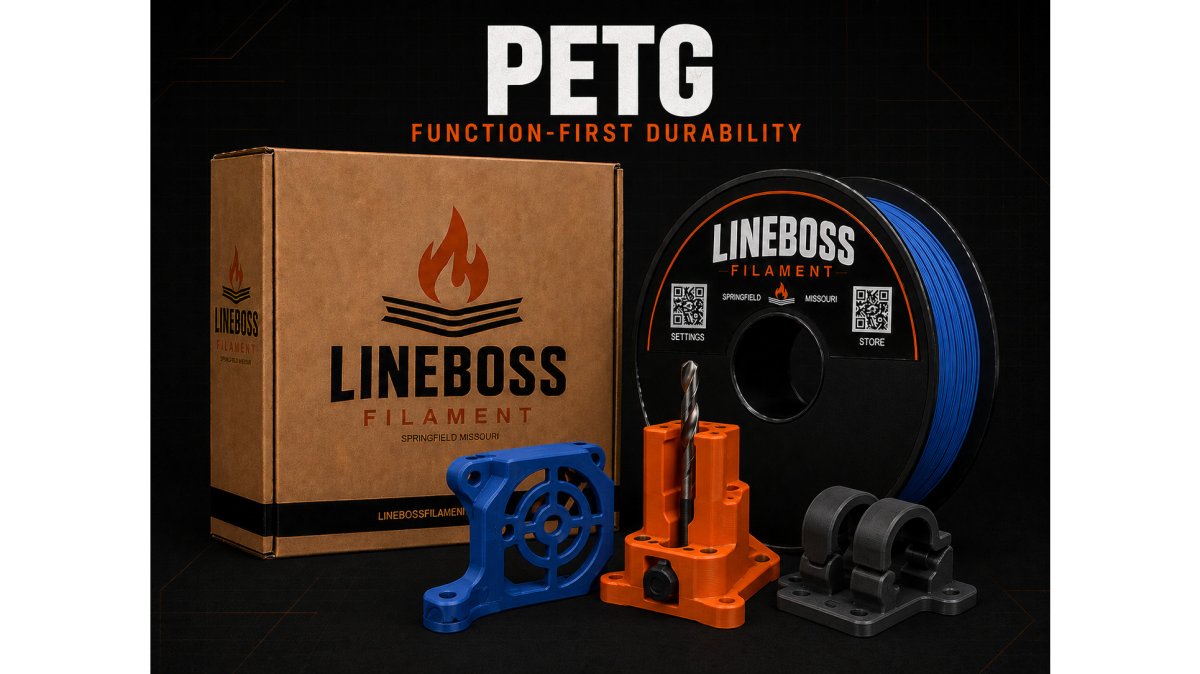
Where PETG earns its place is in everyday functional printing.
Is PLA Food Safe for 3D Printing?
PLA is not automatically food safe, and the finished print matters more than the spool. Food-contact suitability depends on the base polymer, the colorants and additives in a specific product, and the finished surface.

Heat is the second strike. PLA softens at low temperatures, so hot wash water is enough to warp a part and open gaps between layers. Anyone weighing the two materials for washable parts can read more in choosing between PLA and PETG.
Higher-Heat Alternatives: ABS and ASA
ABS and ASA both tolerate heat better than PLA or PETG, which puts them in the conversation for warm-water use. ABS brings strength, toughness, and heat resistance, and LineBoss ABS filament is engineered to reduce cracking and warping on large prints, with low odor.
Neither material is a shortcut. Both want an enclosure, a stable chamber temperature, and ventilation, and both are harder to print than PETG. Check the ABS filament and ASA filament pages for specs before committing.


Food-Safe Coating for 3D Prints
Coatings address the surface problem, not the heat problem. A food-contact-rated epoxy or a suitable sealant can smooth layer lines and close the pores that trap residue, which is why coated prints appear in food-service discussions.
Watch out: a coating that survives a wash does not upgrade the plastic underneath. If the base part warps, the coating cracks with it.
Best Food-Safe Filament for 3D Printing
No filament is food safe on the spool alone. Food-contact suitability depends on the base polymer, the colorants and additives in that specific product, and the surface of the finished print.
What a maker can do is narrow the field. Start with a manufacturer that documents its material composition, choose natural or explicitly food-contact-rated variants where offered, print at high infill with enough walls to minimize porosity, and seal the surface if the part will contact food repeatedly.
Testing a Printed Part Before It Goes in the Dishwasher
Test the actual part, not a coupon. Print the real geometry in the real material with the settings it will ship with, because thin features and tall walls behave differently from a flat test square. Then run a staged protocol and inspect after each stage. This is an informal durability check, not a certification, and a pass does not make the part food safe.
A Repeatable Test Protocol
- Print the final part at production settings. Record the material, nozzle and bed temperatures, wall count, infill pattern and density, and whether an enclosure was used. These variables change results more than the material label.
- Measure key dimensions with calipers. Pick the features that matter for fit, such as overall length, wall thickness, and any mating surfaces, and write the numbers down.
- Run one full cycle on the top rack, away from the heating element. The top rack sees less direct heat and less mechanical load from spray arms. Use the cycle and detergent the part will actually see in service.
- Re-measure and inspect. Compare dimensions to the baseline, then look for warping, layer separation, surface crazing, and color change. Photograph the part under consistent lighting so later comparisons are meaningful.
- Repeat for five cycles, inspecting after each. Five cycles is a reasonable screening window, not a guarantee. Stop at the first sign of distortion or cracking.
- Record the outcome. Note which cycle failed and how, so the next material or geometry change is informed rather than guessed.
What to Look For
- Warping: Overall twist, bowing, or a flat face that no longer sits flat. This usually points to a Tg problem or uneven wall thickness.
- Dimensional change: Caliper readings that drift beyond your fit tolerance, even if the part looks fine.
- Layer separation and cracking: Gaps between layers or hairline cracks, which point to layer bonding and print settings rather than the material alone.
- Surface damage: Crazing, cloudiness, or a chalky film, which suggests detergent attack or gradual aging.
What a Pass Does and Does Not Mean
A part that passes five cycles is a reasonable candidate for regular use in that specific dishwasher with that specific detergent. It is not certified for food contact, and it is not a guarantee against long-term aging. One that fails on cycle one is a material or geometry problem no coating will solve. LineBoss offers material-specific setup support that can help establish a baseline for technical parts. For planning repeated test prints, the 3D printing cost calculator helps, and the slicer settings resources explain the parameters that affect layer bonding.
Watch out: a part that passes this protocol is still not a substitute for a manufacturer's food-contact documentation.
Frequently Asked Questions
What filament is dishwasher safe?
No filament is universally dishwasher safe, because dishwasher performance depends on the part's geometry, wall thickness, and the specific wash cycle. PETG, ABS, and ASA handle heat better than PLA, but each has trade-offs in warping, printability, and long-term durability. Check the material's heat resistance against your dishwasher's wash and heated-drying temperatures, then test a sample part before committing a full batch.
Is 3D printed PLA dishwasher safe?
PLA is generally not a good choice for dishwasher use. It has the lowest heat resistance of the common filaments and can soften, warp, or lose dimensional stability in hot water and heated drying cycles. If a part must survive repeated washing, move to PETG, ABS, or ASA and confirm the print settings against the material maker's documentation before printing.
Are PETG 3D prints dishwasher safe?
PETG is more heat-resistant than PLA and resists water and many chemicals, which makes it a practical starting point for dishwasher-adjacent parts. It is not automatically dishwasher safe, though. Thin walls, poor layer adhesion, and high-temperature sanitizing cycles can still cause distortion. Print a test piece, run it through a full cycle, and inspect for warping or layer separation before trusting a larger print.
Can a food-safe coating make a 3D print dishwasher safe?
A food-safe coating can seal layer lines and reduce bacterial retention on the surface, but it does not raise the underlying filament's heat resistance. If the plastic softens or warps in the wash cycle, the coating will crack or peel with it. Use a coating as a hygiene measure on a heat-resistant material, not as a substitute for choosing the right filament.
How can you tell whether a filament is suitable for repeated dishwasher cycles?
Start with the material's published heat resistance and glass transition temperature, then compare those figures to your dishwasher's wash and drying temperatures. Print a small test part with the same settings you plan to use, run it through several cycles, and check for warping, layer separation, and surface degradation. LineBoss publishes starting profiles and offers setup support to help you establish a reliable baseline.
Dishwasher-safe 3D printing rewards makers who test rather than assume. LineBoss Filament supplies PETG, ABS, and ASA with tight diameter tolerance, vacuum sealing, and practical starting profiles, plus product-specific help when a print needs tuning. Get started with LineBoss Filament and print functional parts with materials you can actually verify.
