Material guide
Is a Dry Box or Active Dryer Better for ABS?
From planning to printing
Find material for your next print
Compare current colors, prices, and setup requirements before choosing a spool for your project.
Share this guide
Get the article link

Last Updated: November 5, 2026
Quick Summary
An active filament dryer removes moisture that ABS has already absorbed, while a dry box only prevents reabsorption during storage. Spools that show popping, bubbling, or rough walls usually need active drying first, then sealed storage afterward.
- A dry box is sealed storage with desiccant and adds no heat, so it cannot remove existing moisture.
- An active filament dryer heats the spool and drives moisture out of the material.
- ABS absorbs water from ambient air over time, and wet filament can cause bubbling and popping.
- Use the filament maker's recommended drying temperature and time, and never raise temperature beyond the maker's limits.
- Many users need both: an active dryer to recover a spool, then a dry box to store it between prints.
Table of Contents
- Dry Box or Active Filament Dryer: What Each One Actually Does
- Why ABS Is Sensitive to Moisture
- How to Dry ABS Filament
- ABS Filament Drying Temperature and Time
- Signs of Wet ABS Filament
- Printing ABS From a Filament Dryer
- Choosing Your ABS Drying Setup Next
- Frequently Asked Questions
The short answer is that an active filament dryer and a dry box do different jobs. For ABS, the choice depends on how wet your filament already is and how long it will sit between prints. Both tools can keep filament usable, but only one of them can remove moisture that is already in the spool.
Dry Box or Active Filament Dryer: What Each One Actually Does
A dry box is a sealed container that protects filament from humidity. It typically holds desiccant and keeps the spool isolated from the room air while it is printed. A dry box does not add heat, so it cannot pull out water the filament has already absorbed.
An active filament dryer, such as the LineBoss HD100 Filament Dryer, heats the spool and drives moisture out of the material. The HD100 heats filament evenly, supports visual operation, and offers timed drying. Active drying is the step to take when filament has been exposed to air. A dry box is then the right place to store it afterward.

In short, a dry box prevents reabsorption, while an active dryer removes moisture that is already there. Many users need both: an active dryer to recover a spool, then a dry box to keep it dry between sessions. For a broader look at buying criteria in this category, see Filament Dryers for Consistent 3D Printing: What to Look For.
Why ABS Is Sensitive to Moisture
ABS absorbs water from ambient air over time (ncbi.nlm.nih.gov). When the filament contains moisture, the water turns to steam inside the hot end, which can cause bubbling, popping, and rough surfaces. Wet filament can also produce weak layer bonds and brittle parts.
ABS is generally less hygroscopic than nylon, but it still benefits from careful storage, especially in humid rooms. The effect is most noticeable on fine details and on parts that need strength. Readers printing functional parts should treat moisture control as a standard part of their workflow rather than an optional extra.
How to Dry ABS Filament
Begin by checking the spool's condition. Filament that has sat in an open bag or a humid room is a good candidate for active drying. Filament that has only been stored in a sealed container with desiccant may need little or no drying.
When drying, set the dryer to the temperature recommended by the filament maker, and keep the spool moving freely so the heat reaches the full length of filament. Dry for the time the material maker specifies, then move the spool straight to a sealed container or print it promptly.
The article's key steps for drying ABS, summarised for quick reference.
| Step | What to do | Time or frequency |
|---|---|---|
| Check the spool | Look for filament that sat open or in a humid room | Before every drying run |
| Set the temperature | Use the filament maker's recommended temperature | Per the maker's documentation |
| Keep the spool moving | Ensure it rotates freely so heat reaches the full length | Throughout the drying cycle |
| Dry for the specified time | Follow the material maker's time | As the maker specifies |
| Store promptly | Move the spool to a sealed container or print it | Immediately after drying |
ABS Filament Drying Temperature and Time
Drying ABS is not a single recipe. The right temperature and time depend on the specific ABS product, the spool it ships on, the dryer's airflow and temperature stability, and how much moisture the filament has absorbed. The material maker's documented limits always come first, because temperatures set too high can deform the spool or soften the filament before it is dry.
A common pattern among ABS makers is a drying range that sits below the material's glass transition and well below its print temperature, with time scaled to spool size and moisture load. Rather than applying a universal number, work through these variables:
- Material documentation. Start with the filament maker's published drying temperature and time. If the maker publishes a range, begin at the lower end and extend time rather than raising temperature.
- Spool material. Many spools are molded from ABS, PS, or PLA. A dryer set near the upper end of an ABS drying range can soften a PLA or PS spool even when the filament itself tolerates the heat. Check the spool's marked material and maximum temperature.
- Moisture load. A spool that sat open in a humid room needs longer than one pulled from a sealed bag. Time, not temperature, is the safer lever to increase.
- Dryer behavior. Dryers differ in airflow, chamber uniformity, and how accurately they hold a setpoint. A dryer with weak airflow may need more time to move moisture out of the spool's core.
Check your filament's documentation before setting a dryer, and confirm the spool's temperature rating before a long run.
LineBoss HD100 Filament Dryer →
Watch out: raising temperature to shorten a dry cycle is the most common way to warp a spool or partially soften filament; if a spool is still wet after the maker's recommended time, add time in increments and re-check rather than pushing the setpoint higher.
After drying, move the spool directly into a sealed container with desiccant or print it promptly. Letting a freshly dried spool sit in room air undoes the work, especially in a humid space.
Signs of Wet ABS Filament
Wet filament shows up in the print itself. Common symptoms include audible popping or sizzling at the nozzle, bubbles on the surface of walls, rough or fuzzy outer layers, and stringing that appears even after retraction is tuned. Layer adhesion may also weaken, leaving parts that crack along layer lines.
These symptoms can have other causes, including nozzle temperature, cooling, and slicer settings. If a spool printed well when new and now shows several of these signs together, moisture is a likely cause and worth testing with a drying run.
Printing ABS From a Filament Dryer
Some users print directly from an active dryer, which keeps the filament warm and dry at the feed. This works best when the dryer sits close to the printer and the filament path is short and low-resistance. Keep the spool centered, confirm it rotates freely, and make sure the feed path is clear.
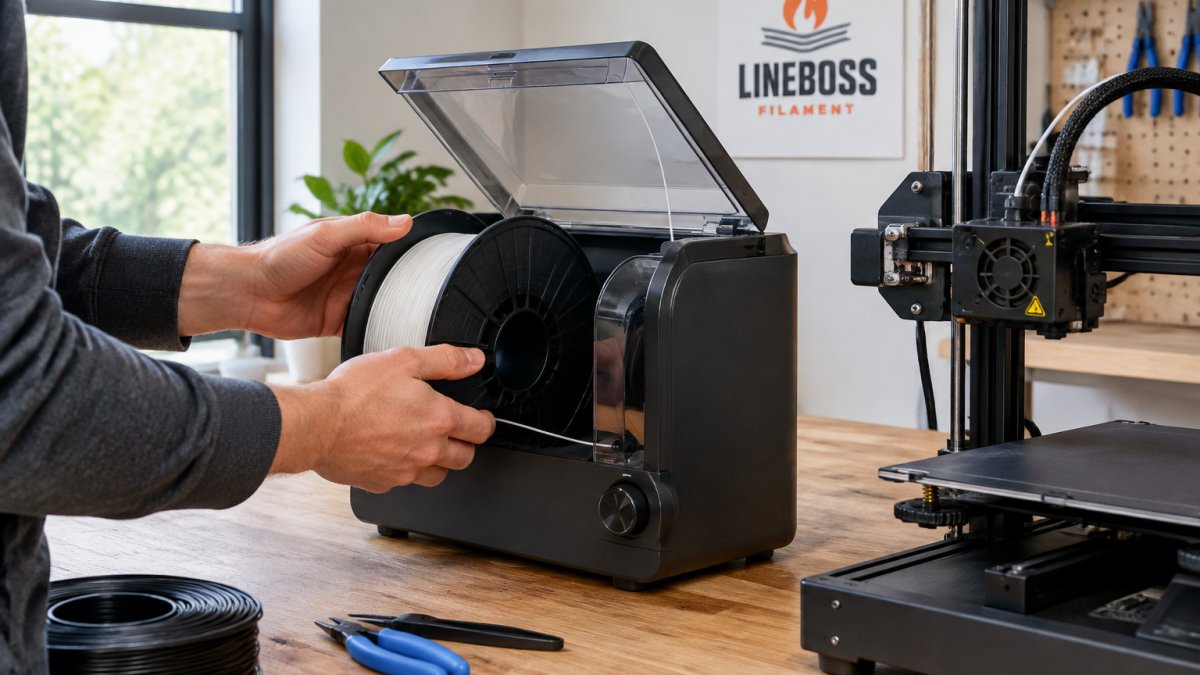
Printing while drying is convenient, but the dryer's own heat and the printer's enclosure conditions affect results. Follow the material maker's guidance for enclosure temperature and ventilation, and confirm the setup with a test print before committing to a long job. The LineBoss ABS Filament listing recommends an enclosure, a stable chamber temperature, and appropriate ventilation, and its applications include tools, toys, phone cases, sport camera mounts, and electrical enclosures.

Choosing Your ABS Drying Setup Next
Most guides treat "dry box or active dryer" as a binary purchase question. For ABS, it is better framed as a decision based on how the spool has been exposed and what symptoms you are seeing. Work through this sequence:
- Is the spool already wet? If you see popping or sizzling at the nozzle, surface bubbles, rough walls, or stringing that persists after retraction is tuned, the filament likely holds moisture and needs active drying before storage can help.
- How was it stored? A spool that has lived in a sealed container with fresh desiccant and shows no symptoms may only need continued dry storage. A spool opened to room air, especially in a humid space, is a drying candidate.
- How often do you print ABS? Frequent printing from opened spools favors an active dryer plus a dry box for between-session storage. Occasional printing from sealed spools can often be handled with a dry box alone.
- What is the total cost of ownership? Compare purchase price, operating energy, and desiccant replacement over time. A dry box is inexpensive to buy and run but cannot recover a wet spool; an active dryer costs more upfront and draws power during cycles but replaces the need to discard marginal filament. Use the https://linebossfilament.com/pages/3d-printing-cost-calculator to estimate costs for a print run.
A practical default for ABS is a two-stage workflow: an active dryer to recover spools that show moisture symptoms, then a sealed dry box with desiccant to hold them between prints. That combination covers both failure modes, moisture already absorbed and moisture reabsorbed during storage, without overbuying for a spool that only needs protection.
For a practical next step, read about drying filament with a dedicated filament dryer and then choose the setup that fits your storage habits. For the slicer settings that pair with ABS, review the resources at https://linebossfilament.com/pages/slicer-settings, and use the https://linebossfilament.com/pages/3d-printing-cost-calculator to estimate the cost of a print run.
Frequently Asked Questions
Does ABS filament need to be dried before printing?
ABS absorbs moisture from ordinary room air over time, and damp spools can cause surface defects, brittle parts and poor layer bonding. Spools that have been open for a while, or that have sat in a humid space, are the most likely to need drying. If a spool has been sealed with desiccant since it arrived and you print it soon after opening, drying may be unnecessary. When in doubt, dry it. Check the spool's condition and your printer's output before deciding, and match the drying temperature to the ABS material's guidance.
Is a dry box enough to keep ABS filament dry?
A dry box is good for storage. It slows moisture reabsorption when filament is already dry and sealed with desiccant. It does not remove moisture that is already in the spool, so a spool that has absorbed water still needs active drying before a dry box will keep it in good condition. Use a dry box after drying, not as a replacement for drying.
What is the difference between a filament dry box and an active dryer?
An active filament dryer heats the spool so moisture leaves the material, and some models allow printing directly from the dryer. A dry box is a sealed container that keeps humidity low around filament that is already dry. Active dryers address moisture that is already present; dry boxes help prevent new moisture from entering. Many users pair both: drying with a heater, then storing in a dry box until printing.
How long should ABS filament be dried?
Drying time depends on how much moisture the spool has absorbed, the dryer's temperature and the spool size, so no single number applies to every spool. Follow the material maker's documented drying guidance and the dryer's own timer settings as your starting point. Check the spool after drying and adjust your routine if prints still show moisture symptoms. See the LineBoss HD100 product page for drying details.
