Material guide
Which Filament Is Best for 3D Printed Garden Stakes?
From planning to printing
Find material for your next print
Compare current colors, prices, and setup requirements before choosing a spool for your project.
Share this guide
Get the article link

Last Updated: October 26, 2026
Quick Summary
The best filament for 3D printed garden stakes is PETG. It handles moisture, resists impact, and prints without the enclosure that ASA and ABS demand. For garden stakes that sit in soil through a full season, PETG is the practical default.
- ASA is the pick for full-sun and high-heat exposures, but it requires an enclosure.
- Print stakes upright so layer lines run lengthwise and resist bending.
- A hollow stake with thick walls beats a solid stake with thin walls at the same filament cost.
- Add two or three extra perimeters to the bottom 100-150 mm of the stake.
- Keep infill modest at 15-25% and let the walls carry the load.
Table of Contents
- Best Filament for 3D Printed Garden Stakes: The Short Answer
- Material Comparison Table for Garden Stakes
- PETG vs PLA for Outdoor Use: Which Handles a Garden Bed?
- UV Resistant 3D Printing Filament: ASA, ABS, and What Sunlight Does
- Outdoor 3D Print Durability: Soil, Fertilizer, and Wet-Dry Cycles
- Stake Geometry, Print Orientation, and Wall Thickness
- 3D Printed Plant Labels and Plant-Contact Safety
- Pick Your Spool and Start Printing Stakes
- Frequently Asked Questions
Best Filament for 3D Printed Garden Stakes: The Short Answer
The best filament for 3D printed garden stakes is PETG. It handles moisture, resists impact, and prints without the enclosure gymnastics that ASA and ABS demand. For stakes that sit in soil through a full season, PETG is the practical default. This guide from LineBoss Filament walks through the trade-offs so you can match material to climate and purpose.

Here's the part most guides gloss over: garden stakes fail at the layer lines, not the material itself. Orientation and wall count matter as much as the spool you load.
Best for: raised beds, tomato cages, row markers, and season-long outdoor use. Skip if: your stakes face constant direct sun in a hot climate, where ASA earns its keep.
Material Comparison Table for Garden Stakes
Four materials cover nearly every garden stake project. The table below summarizes how each behaves outdoors.
| Material | UV Resistance | Moisture | Heat Tolerance | Print Difficulty | LineBoss Price |
|---|---|---|---|---|---|
| PETG | Moderate | High | Moderate | Low | $12.99 |
| ASA | High | High | High | High (enclosure) | $18.99 |
| ABS | Moderate | High | High | High (enclosure) | $17.99 |
| PLA+ | Low | Low | Low | Low | $14.99 |
PETG wins on balance. ASA wins on sun exposure. PLA+ wins only on indoor starts and short-term labeling.
PETG vs PLA for Outdoor Use: Which Handles a Garden Bed?
PETG handles a garden bed far better than PLA. PETG is water-resistant and impact-resistant, while standard PLA softens in heat and degrades under moisture and sunlight over repeated cycles.
PLA's weakness is cumulative. A stake that looks fine in April can sag by July once soil moisture and afternoon heat work on it. PLA+ improves toughness and heat resistance slightly over standard PLA, but it is still the wrong pick for permanent outdoor installations.
PETG's advantage is layer adhesion and low warping, which matters when a stake takes a knock from a trowel or a boot. LineBoss PETG is listed for outdoor tools and durable functional creations, which is exactly the category a garden stake falls into.
For a deeper dive on outdoor material choice, consider how ASA and PETG behave side by side.
Best for: season-long stakes, wet climates, raised beds. Skip if: you only need labels for seedling trays indoors.
UV Resistant 3D Printing Filament: ASA, ABS, and What Sunlight Does
Sunlight breaks down most plastics through UV exposure, and ASA is the filament formulated to resist it. LineBoss ASA is built for UV and weather resistance, limiting environmental stress cracking while holding stability in sun, rain, and harsh climates.
ABS offers high heat resistance and toughness, but it lacks ASA's UV stabilization. A black ABS stake in full sun will chalk and embrittle faster than the same part in ASA.
ASA's cost is process, not price. It wants an enclosure, controlled cooling, and ventilation. LineBoss can help with setup, and the LineBoss ASA filament listing spells out the recommended conditions.

Watch out: printing ASA in an open frame invites warping and layer splits, and those splits become the first place a stake snaps.
Best for: full-sun exposures, hot climates, long service life. Skip if: you cannot enclose your printer.
Outdoor 3D Print Durability: Soil, Fertilizer, and Wet-Dry Cycles
Outdoor 3D print durability comes down to how a part handles repeated wet-dry cycling, soil contact, and chemical exposure. Stakes live in the worst conditions a print will ever see: damp soil, fertilizer salts, and freeze-thaw swings. Most outdoor-filament guides treat "outdoors" as one condition. A garden stake actually faces three distinct stressors at once, and each one attacks a different part of the print.
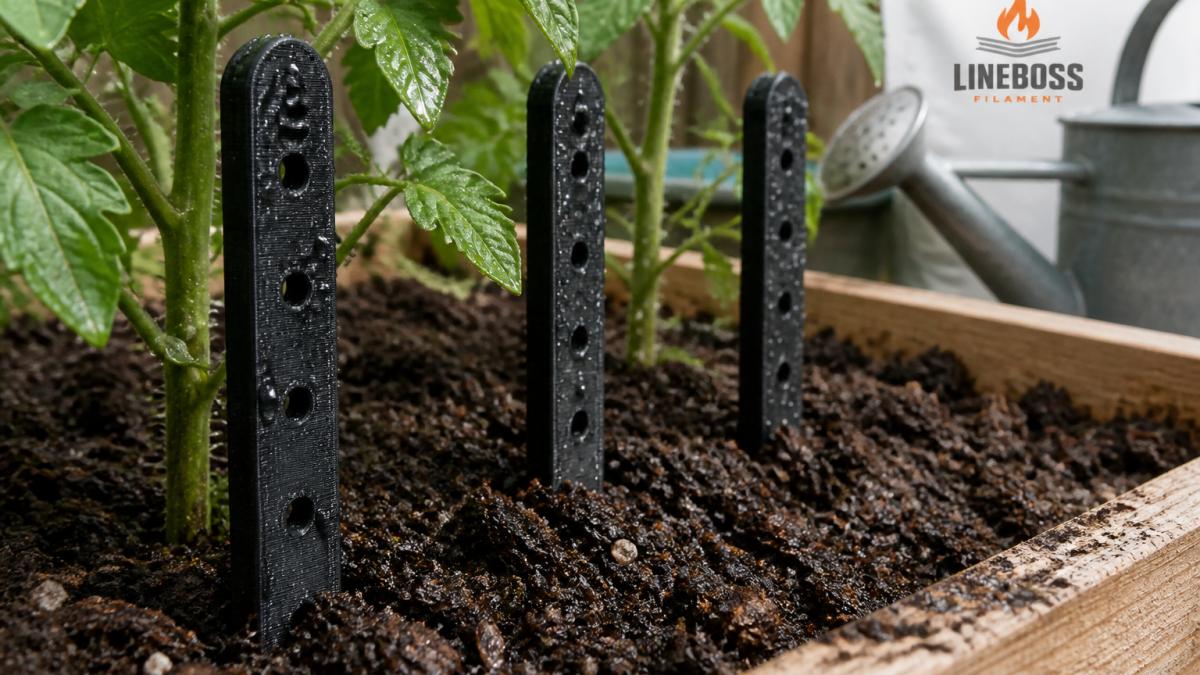
Stressor 1: Moisture and wet-dry cycling. Water enters a print through layer seams and micro-voids, then expands slightly as it warms and contracts as it cools. Over a season, that pumping action widens seams. PETG absorbs very little water and holds its dimensions through cycles, which is why it is the default for buried stakes. PLA is the opposite: it hydrolyzes over time, and each wet-dry pass weakens the bond between layers.
Stressor 2: Fertilizer and soil chemistry. Granular fertilizers are salts. Dissolved salts wick into layer seams and crystallize as the soil dries, and the crystallization pressure pries seams apart. This is a mechanical attack, not just a chemical one, and it favors prints with fewer and tighter seams. A smooth, high-wall-count print gives salts fewer places to sit.
Stressor 3: Freeze-thaw and ground movement. In cold climates, water trapped in seams freezes and expands. Soil also heaves as it freezes and thaws, which loads the buried section of the stake in bending. Materials that stay slightly ductile in cold (PETG, ABS) tolerate that movement better than stiff, brittle prints. ASA holds up well to sun and heat but is stiffer, so the buried section benefits from extra perimeters regardless of polymer.
A practical way to think about it: pick a moisture-resistant material, then print it dense enough that water has nowhere to wick, and design the buried section to take bending rather than tension. Material choice sets the ceiling; geometry decides whether you reach it.
For cost-per-stake math across materials and print settings, the 3D printing cost calculator lets you compare a dense PETG stake against a thinner ASA one before you commit a spool.
Stake Geometry, Print Orientation, and Wall Thickness
Print orientation decides where a stake breaks. A stake printed flat on its side puts layer lines perpendicular to the bending load, which is the weak direction. Printing vertically keeps layer lines running along the stake's length, so the layers resist bending together. This is the single highest-leverage decision in the whole build, and it costs nothing but a taller print.
Cross-section matters more than infill. A garden stake is a beam in bending, and bending strength scales with the distance of material from the neutral axis. That means a hollow stake with thick walls beats a solid stake with thin walls at the same filament cost. A round or oval cross-section resists buckling in any direction; a flat blade-style stake is stiffer in one axis but snaps when loaded sideways. For tomato stakes and row markers that get pushed and pulled, round or oval is the safer default.
Wall count at the ground line. The buried section takes the highest bending moment because soil pressure and stake-top loads both peak there. Adding two or three extra perimeters to the bottom 100-150 mm of the stake costs little filament and moves the failure point away from the soil line. A common pattern is to keep the above-ground section at three perimeters and bump the buried section to five or six.
Tip design. A blunt tip compresses soil and splits the print along layer lines on entry. A small chamfer or a short taper spreads the insertion load and lets the stake enter without splitting. Avoid sharp points: they concentrate stress and snap off in hard ground.
Infill is secondary. For a thin stake, perimeters carry the load and infill mostly prevents wall buckling. A modest infill (15-25%) with high wall count outperforms a solid core with thin walls. Save the filament for walls.
Practical settings to start from:
- Print stakes upright so layers run lengthwise
- Use a round or oval cross-section for all-direction bending
- Increase perimeters on the buried section
- Add a small chamfer at the tip so it enters soil without splitting
- Keep infill modest; walls do the work
These are starting points, not universal numbers. The right wall count and infill depend on your nozzle size, layer height, and the loads your stakes actually see. The slicer settings reference walks through how wall count, layer height, and orientation interact, and the PETG print settings guide for beginners covers temperature and speed starting points for the material itself.
3D Printed Plant Labels and Plant-Contact Safety
3D printed plant labels raise a fair question: is the plastic safe next to something you eat? The honest answer is that material choice and print finish both matter, and no filament is certified food-safe after printing on a typical hobby machine.
Layer lines harbor moisture and soil, which is where microbes settle. A smooth, well-bonded print is easier to clean than a rough one. Keep printed labels out of direct contact with edible plant parts where you can, and treat them as garden hardware rather than food-contact items.
PETG and ASA are the more sensible choices here because they resist moisture and do not break down the way PLA does in wet soil.
This is a case where the cautious answer is the right one. Print labels you can wipe down, and keep them at the soil line rather than wrapped around stems.
Pick Your Spool and Start Printing Stakes
The material decision is settled: PETG for most garden stakes, ASA for full-sun and high-heat exposures, PLA+ only for indoor starts. The rest is geometry and patience.
LineBoss Filament stocks PETG with +/-0.02mm diameter tolerance and vacuum sealing with desiccant, so spools arrive dry and extrude consistently. The LineBoss PETG filament listing covers the outdoor tool applications directly. Free U.S. shipping applies over $50, and product-specific setup support is available if a profile needs tuning.
Get started with LineBoss Filament and print stakes that survive the season, not just the weekend.
Frequently Asked Questions
What is the strongest 3D printing filament for garden stakes?
Strength depends on what you mean. ASA handles sunlight and heat best, which matters because a stake that goes brittle in UV will snap at the soil line. PETG brings high impact resistance and water resistance at a lower price. ABS is strong and heat resistant but degrades faster in direct sun than ASA. PLA+ is the toughest of the easy-printing options but softens in a hot car or greenhouse. For a stake that stays outside year-round, ASA is the safest pick; for seasonal use, PETG covers most gardens well.
Is PETG or PLA+ stronger for outdoor garden stakes?
PETG wins on outdoor durability. It resists water, takes impacts without shattering, and holds up to summer heat better than PLA+. PLA+ is tougher than standard PLA and bends slightly before breaking, but it still softens at lower temperatures and degrades faster under UV and moisture. If your stakes stay in the ground through winter or sit in full sun, print them in PETG. PLA+ makes sense for short-season labels and starter markers you plan to reprint.
Does PLA filament hold up outdoors in sunlight and rain?
Not for long. PLA absorbs moisture over repeated wet-dry cycles, which weakens layer adhesion, and sunlight breaks it down over months. Heat is the bigger problem: a stake in direct summer sun or a closed greenhouse can soften enough to bend under its own load. PLA and PLA+ work for a single growing season in a shaded bed, or for plant labels you refresh each spring. Treat them as temporary outdoor parts, not permanent installations.
How thick should a 3D printed garden stake be, and does infill matter?
Walls do more for stake strength than infill. Aim for at least three perimeters so the outer shell carries bending loads, and use 30 to 50 percent infill for the core. A stake that is too thin snaps at the soil line where moisture and leverage combine. Print stakes flat on their side or standing with the layer lines running along the length, not across it, so layers resist bending instead of peeling apart. Check your slicer profile at linebossfilament.com/pages/slicer-settings before a long print.
